Japan Travel Planning Guide: How to Plan a Trip (2026-2027)
Japan travel planning guide: 12 steps covering when to go, how long to stay, costs, visa, trains, hotels, money and 2026-2027 rule changes.
By Yuuna·Updated
Japan trip planning comes down to a dozen decisions, and most of them depend on the ones before. When you go decides how crowded and how expensive it is. How long you stay decides how many cities you can fit in. Your passport decides what paperwork you need. This Japan travel planning guide walks through those decisions in order, with current numbers, and links to a deeper guide whenever one exists.
Updated October 21, 2026. Sources are the Japan Tourism Agency, JNTO, JMA, the Ministry of Foreign Affairs and Japan Guide; per-night figures and spending shares are our calculations from them.
Everything below is for visitors from any country, except where a rule depends on your passport. Prices and rules in Japan changed a lot in 2026 (the departure tax, the Japan Rail Pass, tax-free shopping and several hotel taxes), and more changes are scheduled for 2027. The sections below flag them.
How to plan a trip to Japan: pick your dates first, then choose two or three bases, set a budget, check your entry rules, book flights and trains, reserve hotels, and finish with money, phone and time-limited bookings. Each step below says what to decide and links to a deeper guide.
Key Takeaways
- Plan in this order: dates, trip length and route, budget, entry paperwork, flights, trains, hotels, then money and connectivity.
- Best timing: late March to early April for cherry blossom, or mid-November to early December for autumn colour. Our best time to visit Japan guide has the month-by-month data.
- A realistic budget: the average leisure visitor spent about ¥225,000 over 7.1 nights in 2025, roughly ¥31,700 a night spent in Japan (calculated from Japan Tourism Agency figures: ¥224,806 ÷ 7.1 nights). That is spending in Japan, not a total trip price including flights.
- Two bases cover a first trip well: Japan Guide's 7-day and 10-day sample itineraries split the nights between Tokyo and Kyoto only.
- Rules changed in 2026: departure tax ¥3,000 (July 1), Japan Rail Pass prices up (October 1; check which price applies), and tax-free shopping becomes a refund system on November 1.
- Book ahead for a few things: the Ghibli Museum, teamLab, Mt. Fuji climbing and oversized-luggage seats on the Shinkansen.
The Plan at a Glance: Twelve Decisions in Order
| Step | Decision | Short answer | Jump to |
|---|---|---|---|
| 1 | When to go | Late March to early April, or mid-November to early December | Step 1 |
| 2 | How long and where | 7 to 10 days works for Tokyo and Kyoto; 14 days adds more stops | Step 2 |
| 3 | Budget | About ¥31,700 per night in Japan for the average leisure visitor | Step 3 |
| 4 | Entry and paperwork | Many nationalities need no visa for short stays; check MOFA for yours | Step 4 |
| 5 | Flights and airports | Pick your airport and transfer before you book | Step 5 |
| 6 | Trains and local transport | Shinkansen, an IC card, and a JR Pass only if the maths works | Step 6 |
| 7 | Where to stay | Business hotel, ryokan or both; mind the new hotel taxes | Step 7 |
| 8 | Money | Cards are widely accepted; carry some cash; tax-free rules change November 1 | Step 8 |
| 9 | Phone, power, emergencies | 100 V power, a SIM or pocket Wi-Fi, and the 110 and 119 numbers | Step 9 |
| 10 | Etiquette | Quiet trains, no tipping, wash before the onsen | Step 10 |
| 11 | Book-ahead list | Ghibli, teamLab, Mt. Fuji, oversized-luggage seats | Step 11 |
| 12 | Health and safety | Insurance, medicine rules, earthquake and typhoon basics | Step 12 |
Step 1: Choose When to Go
Japan's busiest months in 2025 were April (3.91 million visitors) and October (3.90 million), and the quietest were February and September, per JNTO's monthly tables. The gap between busiest and quietest is only about 20%, so there is no truly empty season. What changes is the weather and where the crowds gather.
Three windows cover most trips:
- Cherry blossom, late March to early April. Japan Guide's JMA averages put full bloom at March 31 in Tokyo and April 4 in Kyoto and Osaka.
- Autumn colour, mid-November to early December. Japan Guide's October 2026 forecast has Kyoto's colour from mid-November to early December and Tokyo's from late November to early December. Tokyo's average November high is 16.7°C with 96 mm of rain (JMA normals).
- Winter snow, December to April. Ski season peaks in January and February, and the Sapporo Snow Festival runs February 4 to 11 in 2027.
Avoid the Japanese holiday rushes if you can (dates are in our best-time guide): Golden Week (April 29 to May 5), Obon (around August 13 to 16) and the New Year shutdown (around December 29 to January 3). The rainy season runs from about June 8 to July 20 in Tokyo (Japan Guide), and typhoons are most frequent from July to October, peaking in August and September.
Go deeper: the best time to visit Japan guide has month-by-month weather, crowd data, blossom and autumn dates by city, and a goal-by-goal table. If you are weighing a sailing, see the best time for a Japan cruise.
Step 2: Decide How Long to Stay and Where to Base Yourself
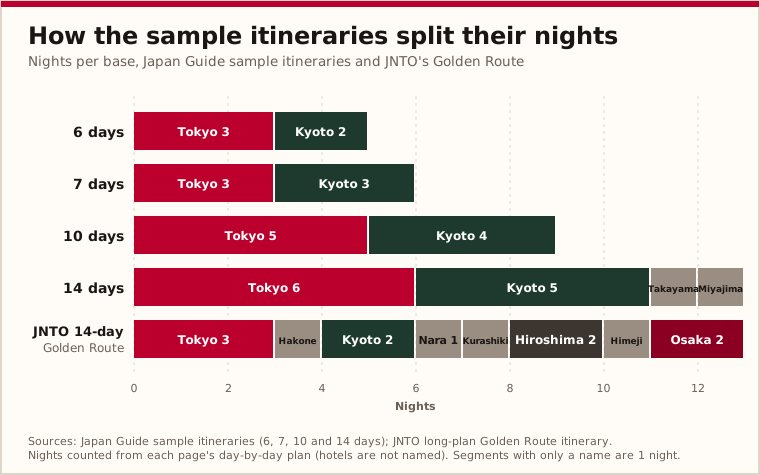
Most first trips use Tokyo and Kyoto as bases, with day trips to nearby places. Japan Guide's sample itineraries show the pattern, and JNTO's longer Golden Route adds more cities.
First-Time Japan Itinerary: 7, 10 and 14 Days
For a first trip, seven to ten days covers Tokyo and Kyoto with a day trip or two; fourteen days adds more stops.
| Trip length | Nights (as laid out in each plan) | Day trips and extras (our suggestions) |
|---|---|---|
| 6 days | Tokyo 3, Kyoto 2 | Short and tight; mostly city sightseeing |
| 7 days | Tokyo 3, Kyoto 3 | Room for one relaxed half-day |
| 10 days | Tokyo 5, Kyoto 4 | Nikko from Tokyo; Nara or Himeji from Kyoto |
| 14 days | Tokyo 6, Kyoto 5, Takayama 1, Miyajima 1 | Kamakura or Nikko; Nara; Hiroshima via Miyajima |
| JNTO Golden Route (14 days) | Tokyo 3, Hakone 1, Kyoto 2, Nara 1, Kurashiki 1, Hiroshima 2, Himeji 1, Osaka 2 | JNTO suggests a 14-day rail pass |
Sources: Japan Guide's 6 to 14-day sample itineraries and JNTO's long-plan itinerary. The pages do not name hotels, so the night counts follow each page's day-by-day plan.
A few planning rules that follow from the data:
- Fewer bases beat more. In our view, every move costs several hours of packing, transit and check-in, and two to three nights suits a main base, and one-night stops work for places like Hakone or Takayama.
- Use day trips for variety. From Tokyo, Nikko and Kamakura; from Kyoto, Nara and Himeji.
- Add Hokkaido or Okinawa only with extra days. There is no through Shinkansen from Tokyo to Sapporo. The line ends at Shin-Hakodate-Hokuto, and the extension to Sapporo is delayed to the end of fiscal 2038 (Nippon.com), so plan a flight.
Step 3: Set a Budget
The Japan Tourism Agency's Inbound Consumption Trend Survey gives the best public picture of what visitors actually spend in Japan. In 2025, the average visitor spent ¥228,809 over an average 9.5 nights (all purposes). Tourism and leisure visitors spent ¥224,806 over 7.1 nights. The total across all visitors was about ¥9.46 trillion, up 16.4% on 2024. These are preliminary figures from the survey's January 2026 release.
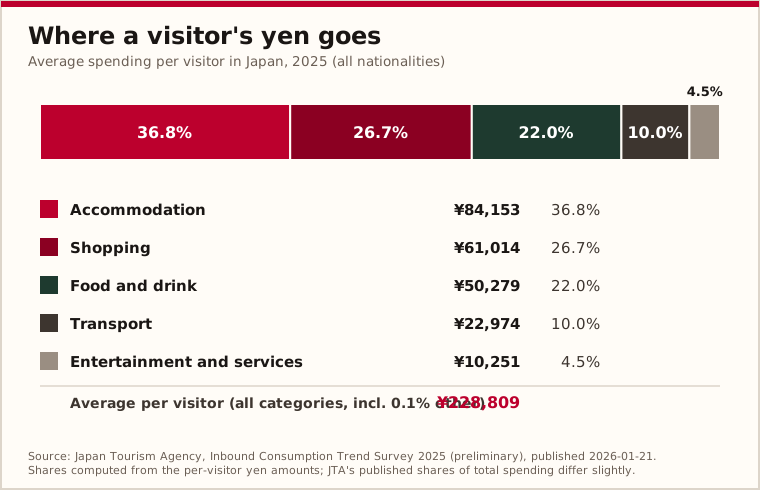
Accommodation is the biggest single cost (about 37%), followed by shopping (about 27%) and food and drink (22%). Transport is only 10%. These shares are computed from the per-visitor yen amounts; the agency's own published shares of total spending differ slightly.
Dividing the leisure figure by the leisure stay gives roughly ¥31,700 per night, or about US$200 at ¥158 to the dollar (the Federal Reserve's H.10 rate for October 16, 2026, at time of writing) or about €179 at ¥177 to the euro (ECB, October 20, 2026). That is an average, not a recommendation. It includes shopping, it blends big spenders with backpackers, it comes from a survey of departing visitors, and it covers spending in Japan rather than your flights. Treat it as a benchmark: a plan well under it is lean, and a plan well over it is generous. As a worked example, seven nights at ¥31,700 comes to about ¥222,000, or roughly US$1,400 at ¥158.
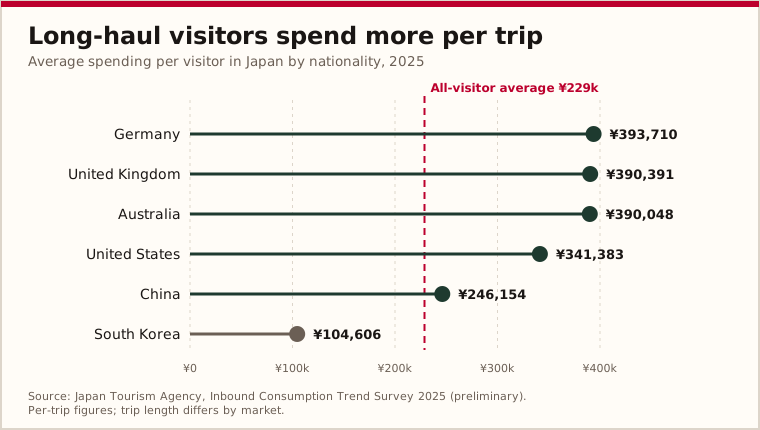
Visitors from Germany, the UK and Australia each spent roughly ¥390,000 per trip, the United States ¥341,383, China ¥246,154 and South Korea ¥104,606. Trip length differs by market, so the per-trip number says as much about how long people stay as how much they spend per day.
Cost levers you control:
- Season. In HotelBank's listed-price data, Kyoto hotels averaged ¥47,500 a night in November 2025 against ¥42,400 in April, ¥36,600 in August and ¥35,100 in July 2025, so November was about 35% above July. This is a single commercial source covering only those months.
- Hotel taxes. See Step 7.
- Rail. A pass is not always cheaper; see Step 6.
- Shopping. More than a quarter of all-visitor spending; decide on a limit before you go.
Step 4: Entry Rules, Visa and Customs
Visa. Many nationalities do not need a visa for short tourist stays. JNTO says no visa is needed for 90 days or less for tourism, and that some nationalities get 15, 30 or 180 days instead. Whether your passport is on the list, and for how long, is set by the Ministry of Foreign Affairs of Japan. Check it there rather than relying on a blog, including this one. If you need a visa, apply through the Japanese embassy or consulate that serves you, since fees and processes depend on nationality.
Passport. You need a valid passport. JNTO's page states no minimum remaining validity, so check with your airline and the embassy for your own rule.
Visit Japan Web. Visit Japan Web is the Digital Agency's online service for immigration and customs information. It is optional: the customs authority still accepts the paper declaration but recommends the online version, which gives one QR code you scan at an e-gate. From November 2026 it also handles the tax-free departure procedure (Step 8).
JESTA (not yet in force). According to The Standard, Japan's Diet passed an amendment in May 2026 creating a pre-travel authorisation for visa-exempt travellers, similar to the US ESTA, with a launch targeted for fiscal 2028 (April 2028 to March 2029). As of October 2026 no fee or start date has been published, and it is not required for a 2026 or 2027 trip. The Immigration Services Agency is the official source to watch.
Customs and medicine. Japan restricts some medicines, and the rules turn on how much you carry. See Step 12.
Step 5: Flights and Airports
Japan's two main gateways are Tokyo (Narita and Haneda) and Osaka (Kansai). Fly into one and out of the other if your route runs from Tokyo to Kyoto and Osaka, so you don't backtrack.
Our guide to the cheapest month to fly to Japan covers fares. Prices differ by route, so use a fare calendar on your own dates.
Departure tax. Japan's International Tourist Tax rose from ¥1,000 to ¥3,000 per person on July 1, 2026, according to JNTO. It is normally included in your air ticket, so you rarely pay it separately.
From the airport to the city. These are Japan Guide's approximate figures from 2025 pages, and operators revise fares, so check the operator before you travel.
| Airport | Option | Time | Fare |
|---|---|---|---|
| Narita | Narita Express to Tokyo Station | about 60 min | about ¥3,140 |
| Narita | Keisei Skyliner to Nippori or Ueno | about 40 min | about ¥2,300 to ¥2,800 |
| Narita | Limousine bus | about 100 min | about ¥3,100 |
| Haneda | Tokyo Monorail to Hamamatsucho | about 15 min | about ¥520 |
| Haneda | Keikyu line to Shinagawa | about 15 min | about ¥330 |
| Kansai | Haruka to Kyoto | about 70 min | about ¥3,000 |
| Kansai | Nankai Rapi:t to Namba | 35 to 40 min | about ¥1,520 |
Sources: Japan Guide Narita, Haneda and Kansai pages (updated 2025). Haneda's monorail and Keikyu stop around midnight.
Step 6: Getting Around by Train, Pass and IC Card
The Shinkansen
The bullet train links Tokyo with Kyoto, Osaka, Hiroshima and many other cities. Japan Guide's figures: Tokyo to Kyoto takes about 2 hours 10 to 20 minutes on the fastest Nozomi and costs ¥13,320 for a non-reserved seat. Tokyo to Hiroshima is about 4 hours direct and ¥18,380 non-reserved. For how the trains run overnight, see is the bullet train in Japan 24 hours.
Oversized luggage. On the Tokaido, Sanyo and Kyushu Shinkansen, JR Central's rule is:
- up to 160 cm (length + width + height): no reservation needed;
- 161 to 250 cm: reserve a seat with an oversized baggage area when you buy your ticket, at no extra charge;
- over 250 cm: not allowed;
- without a reservation, a ¥1,000 fee applies and you may be told to take a later train.
Is a Japan Rail Pass worth it?
For most Tokyo and Kyoto trips, no. The pass rose in price on October 1, 2026. JNTO lists the new adult prices as:
| Pass | Old price | New price |
|---|---|---|
| Ordinary, 7 days | ¥50,000 | ¥53,000 |
| Ordinary, 14 days | ¥80,000 | ¥84,000 |
| Ordinary, 21 days | ¥100,000 | ¥105,000 |
| Green, 7 days | ¥70,000 | ¥74,000 |
| Green, 14 days | ¥110,000 | ¥116,000 |
| Green, 21 days | ¥140,000 | ¥147,000 |
As of October 1, 2026, Japan Guide reported the official pass website was still selling at the old prices "for a limited time" with no end date announced, while travel agencies charged the new prices. Check both before you buy. The pass does not cover Nozomi or Mizuho trains without a supplement, so between Tokyo and Osaka you ride Hikari or Kodama instead.
The sums matter more than the headline. A Tokyo to Kyoto return costs about ¥26,640 (2 × ¥13,320 non-reserved), about half the 7-day pass price. The rule is simple: add up the individual fares for your actual route, and the pass wins only if the total is above its price. A Tokyo to Hiroshima return is about ¥36,760 (2 × ¥18,380 non-reserved), still under ¥53,000 on its own, so a pass pays off only for routes that chain several long rides in the pass window. For a Tokyo and Kyoto trip, individual tickets are usually cheaper.
IC cards
Prepaid IC cards such as Suica, PASMO and ICOCA work on trains, subways and buses in most cities, and in many shops. According to Japan Guide (updated July 2026), Welcome Suica has no deposit and is valid for 28 days, the Welcome Suica Mobile app is iPhone-only, and Tourist PASMO is sold at Narita and Haneda. A regular card carries a ¥500 refundable deposit. Cards from the ten big regional systems are interchangeable. Availability for visitors has changed several times, so check the JR East or PASMO site before you fly.
Sending luggage ahead
Takkyubin (luggage forwarding) is cheap and common. Japan Guide gives rough prices from Tokyo of about ¥3,000 for a suitcase within Greater Tokyo and about ¥3,200 to Osaka or Kyoto, with delivery usually the next day (two days or more to Hokkaido and Okinawa). Hotels, convenience stores and airport counters accept bags. Some small hotels cannot receive deliveries, so ask first.
Step 7: Where to Stay
Japan's mix of accommodation includes business hotels, city hotels, resort hotels, ryokan (traditional inns), guesthouses and capsule hotels. In 2025, Japan Tourism Agency data showed business hotels with the highest occupancy of the major types (65.9%), then city hotels (63.2%), resort hotels (53.6%) and ryokan (34.5%), for all guests rather than visitors from abroad only, as reported by Travel Voice. Popular properties fill early in blossom and autumn weeks, so book with free cancellation.
Ryokan basics, from Japan Guide:
- check-in is usually from 15:00 and dinner is around 18:00 to 19:00, so tell the inn early if you will be late;
- take off your shoes before the tatami and use the separate toilet slippers;
- you can wear the yukata (cotton robe) all day inside the inn, but not everywhere outside;
- futons are laid out in the evening and stored in the morning;
- alcohol is usually extra.
For onsen, see can you visit onsen with tattoos and are onsen hygienic.
Accommodation taxes
Several places have raised or introduced taxes, and Osaka has long had one. All are charged per person per night on top of the room rate:
| Place | Tax | Source |
|---|---|---|
| Kyoto (since Mar 1, 2026) | ¥200 under ¥6,000; ¥400 for ¥6,000 to ¥19,999; ¥1,000 for ¥20,000 to ¥49,999; ¥4,000 for ¥50,000 to ¥99,999; ¥10,000 at ¥100,000 and above | Time Out |
| Tokyo (until Mar 2027) | ¥100 for rooms from ¥10,000 to ¥14,999; ¥200 at ¥15,000 and over; none under ¥10,000 | Impress Travel Watch |
| Tokyo (from Apr 1, 2027) | A flat 3% of the room rate; exempt under ¥13,000 per person per night | Impress Travel Watch |
| Osaka Prefecture (current rates; no 2026 change found) | ¥200 for ¥5,000 to ¥14,999; ¥400 for ¥15,000 to ¥19,999; ¥500 at ¥20,000 and over | Live Japan |
| Hokkaido (from Apr 1, 2026) | Prefectural tax (hotel notices report about ¥100 to ¥500 per person per night by room price); towns such as Sapporo add their own | Hokkaido official site |
Rates are as reported by the sources linked, and local rules change, so confirm the amount with your hotel when you book. Usually you pay it at check-in.
Step 8: Cards, Cash and Tax-Free Shopping
Cards. JNTO says international-brand credit, debit and prepaid cards are generally accepted nationwide, but short-distance train and subway fares and some small shops may not take them. Stores may not show card logos, so ask. Carry some cash anyway.
ATMs. According to Japan Guide, 7-Bank ATMs (at 7-Eleven and other sites, more than 20,000) take foreign cards and run 24 hours. Japan Post ATMs have shorter hours. Check fees and limits with your own bank.
Tax-free shopping changes on November 1, 2026. For purchases on or after that date, shops no longer deduct the consumption tax at the till. Per Japan Guide's summary (dated June 26, 2026):
- you pay the tax-inclusive price in store and get the refund after the departure procedure;
- the minimum is ¥5,000 before tax, in the same store on the same day;
- the old split between general goods and consumables is removed, along with the ¥500,000 consumables cap and sealed packaging;
- you must take the goods out of Japan yourself, and consumables still cannot be used in Japan;
- the departure procedure is at a customs terminal before check-in, or in Visit Japan Web;
- a green result lets you check in; a red result means a customs inspection.
Details at airports may change, so check the Japan Tourism Agency tax-free page and JNTO's explainer close to your date. Budget time for the departure procedure.
Step 9: Phone, Wi-Fi, Power and Emergency Numbers
- Connectivity. JNTO's connectivity page says SIM cards are sold at airports and at electronics stores such as Bic Camera and Yodobashi, and that pocket Wi-Fi rental kiosks are at major airports. Our pocket Wi-Fi review covers one option.
- Power. Japan uses 100 V. The frequency is 50 Hz in the east (Tokyo, Tohoku, Hokkaido) and 60 Hz in the west (Osaka, Kyoto, Hiroshima, Kyushu). Plugs are the two-pin, North American style (Japan Guide). Check that your charger accepts 100 V.
- Emergencies. Dial 110 for police and 119 for fire and ambulance. The JNTO Japan Visitor Hotline is 050-3816-2787 (+81-50-3816-2787), open 24 hours with English, Chinese and Korean support.
Step 10: Etiquette That Matters
JNTO's etiquette guide covers these basics:
- Tipping is not expected. Some izakaya add a small cover charge.
- Shoes come off in some temples, restaurants and ryokan.
- Trash bins are scarce, so carry rubbish until you find one at a station or convenience store, and sort it.
- Eating while walking is not banned, but avoid messy food and open drinks in crowds, and step aside to eat.
- Trains are quiet: keep your voice down and skip phone calls.
- Onsen: wash first, no swimwear, no soap in the bath. Policies on tattoos vary by bath; see our tattoo guide.
Geisha districts. In Kyoto's Gion district, private roads carry signs warning of fines up to ¥10,000 for photography and access restrictions have been reported since 2024 (Time Out). Who sets and enforces the rules is reported differently, so follow posted signs. Our guide on seeing geisha in Kyoto explains how to do it respectfully.
Food. Food is a big part of many trips. Browse our Japanese food guides for dishes to try.
Step 11: What to Book Ahead
Most of Japan needs no advance planning, but a few things do:
| What | What to know | Source |
|---|---|---|
| Ghibli Museum, Tokyo | Advance reservation only; overseas buyers use Lawson Ticket, which opens at 10:00 JST on the 10th of the month before your visit, or a tour package; timed entry | Official site |
| teamLab Planets, Tokyo | Tickets are date- and time-specific and sold in advance | Official site |
| Mt. Fuji climbing (Yoshida trail) | 2027 dates are not yet confirmed. The 2026 season ran July 1 to September 10, with a ¥4,000 hiking fee, a daily cap of 4,000 climbers, and the gate closed 2 pm to 3 am for anyone without a hut booking; a passage reservation is optional | Yamanashi official site |
| Oversized luggage seats | Reserve when you buy a Shinkansen ticket if your bag is 161 to 250 cm | JR Central |
For other timed-entry places, such as observation decks and popular restaurants, book as soon as dates are fixed.
Step 12: Health, Safety and Medicine Rules
- Insurance. JNTO advises arranging travel insurance with adequate coverage before you leave.
- Earthquakes. Stay calm, follow staff instructions, find your hotel's evacuation route, and move to high ground on the coast. JNTO recommends the Safety Tips app and NHK WORLD-JAPAN for alerts.
- Typhoons. They are most frequent from July to October, peaking in August and September. JMA's 1991-2020 statistics show about 11.7 approaching Japan in an average year and 3.0 making landfall, with Okinawa getting more than the mainland. Keep a flexible day in August to October.
- Medicine. Under Ministry of Health, Labour and Welfare rules, you can bring up to a one-month supply of prescription medicine and up to two months of other medicines without an Import Confirmation. Larger amounts need one before you leave. Narcotics and stimulant ingredients are prohibited unless pre-approved. Some common prescriptions in other countries are controlled in Japan, so check the MHLW page and carry your prescription.
What Is Changing in 2026 and 2027
Japan's rules and prices moved a lot in a short time.
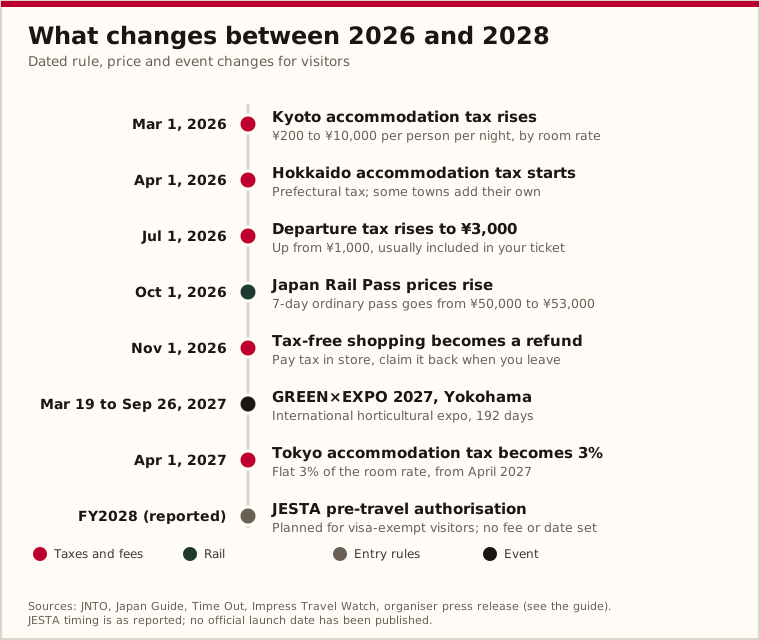
| Date | Change |
|---|---|
| Mar 1, 2026 | Kyoto accommodation tax rises |
| Apr 1, 2026 | Hokkaido accommodation tax starts |
| Jul 1, 2026 | Departure tax rises to ¥3,000 |
| Oct 1, 2026 | Japan Rail Pass prices rise |
| Nov 1, 2026 | Tax-free shopping becomes a refund system |
| Mar 19 to Sep 26, 2027 | GREEN×EXPO 2027, Yokohama |
| Apr 1, 2027 | Tokyo accommodation tax becomes a flat 3% |
| Fiscal 2028 (reported) | JESTA pre-travel authorisation planned |
Two other points for planning:
- Demand is easing slightly. JNTO reports 24,527,200 visitors from January to July 2026, down 1.7% on the same period of 2025, with arrivals from China sharply lower. Peak seasons at the big sights remain busy.
- GREEN×EXPO 2027 runs in Yokohama from March 19 to September 26, 2027, according to the organiser's release, so expect extra domestic visitors in the Tokyo area in spring and summer 2027.
Three Ways to See Japan: Independent, Package Tour or Cruise
Independent travel gives the most freedom and the best price per night if you can book and navigate yourself, and everything in Steps 1 to 12 applies.
Package tours bundle hotels, transport and meals, and are the easiest option if you want everything handled, including dietary needs.
Cruises let you unpack once and wake up in a new port. Our Japan cruise guide covers ports, seasons and costs, best cruise lines for Japan compares ships, and cruise vs independent travel helps you decide.
Pre-Departure Checklist: Japan Travel Tips in Order
- Pick dates and lock a flexible window for blossom or colour (Step 1).
- Choose your bases and day trips (Step 2).
- Confirm your passport and visa status with MOFA, and check validity with your airline (Step 4).
- Book flights and your airport transfer (Step 5).
- Book hotels with free cancellation, and note the accommodation tax (Step 7).
- Reserve time-limited items: Ghibli, teamLab, Mt. Fuji, oversized-luggage seats (Step 11).
- Decide on a rail pass by adding up your actual rides (Step 6).
- Consider registering on Visit Japan Web (optional) and prepare your tax-free departure steps (Steps 4 and 8).
- Arrange a SIM, eSIM or pocket Wi-Fi, and check your chargers take 100 V (Step 9).
- Check medicine rules and carry prescriptions (Step 12).
- Buy travel insurance (Step 12).
- Save the emergency numbers (110, 119 and the JNTO hotline).
Frequently Asked Questions
How do I plan a trip to Japan for the first time?
Choose your dates, then two or three bases (Tokyo and Kyoto suit most first trips), set a budget, check your entry rules, and book flights, trains and hotels. Reserve the few timed-entry items last. The 12 steps above follow that order.
What is the best month to go to Japan?
Late March to early April for cherry blossom, or mid-November to early December for autumn colour, with February and September the quietest months on visitor numbers. See the best time to visit Japan guide for the data.
How far ahead should I plan a trip to Japan?
Settle your dates and flights first, since they decide everything else. For blossom or Kyoto in autumn, book hotels and flights as early as you can with free cancellation. A few things have fixed windows, such as the Ghibli Museum's monthly ticket release.
How many days do I need in Japan? Is 7 days enough?
Seven days works for Tokyo and Kyoto, and ten gives room for a day trip or two, as in Japan Guide's 7-day and 10-day samples. Fourteen days lets you add places like Takayama, Hiroshima and Miyajima, or follow JNTO's Golden Route.
How much does a trip to Japan cost?
The average leisure visitor spent ¥224,806 over 7.1 nights in 2025, about ¥31,700 per night spent in Japan, which is not a total trip price including flights. Across all visitors, accommodation was the largest share (about 37%), then shopping and food. At ¥158 to the US dollar (Federal Reserve, October 16, 2026), that is about US$200 a night; exchange rates move daily.
Do I need a visa for Japan?
It depends on your passport. Many nationalities can visit for up to 90 days without a visa; check the Ministry of Foreign Affairs of Japan for your country.
Is a Japan Rail Pass worth it in 2026?
Often not for a Tokyo and Kyoto trip. A Tokyo to Kyoto return costs about ¥26,640, against ¥53,000 for a 7-day ordinary pass at the new price. Add up your rides before you buy.
Do I need to book hotels in advance?
For blossom season, Kyoto in autumn and the holiday weeks, yes, as early as you can with free cancellation.
Do I need cash in Japan?
Carry some. Cards are widely accepted, but some small shops, train fares and local businesses may not take them, and 7-Eleven ATMs take foreign cards.
What is changing for visitors in 2026 and 2027?
A higher departure tax (¥3,000 from July 1, 2026), higher JR Pass prices (October 1, 2026), a refund-based tax-free system (November 1, 2026), higher or new hotel taxes in Kyoto, Hokkaido and Tokyo, and a planned JESTA authorisation in fiscal 2028.
Where to Go Next: More Japan Travel Guides
Start with the biggest decision, when to go, then pick how to travel: independent, a package or a cruise. Below is every Japan travel guide on this site.
Explore Every Japan Travel Guide
- Best Time to Visit Japan: A Month-by-Month Guide (2026-2027)
- Hakodate Cruise Port Guide: Morning Market & Mount Hakodate
- Hiroshima & the Seto Inland Sea: Peace Park, Miyajima and Shore Excursions
- Kagoshima Cruise Port Guide: Sakurajima Ferry, Volcano Status & Sengan-en
- Kanazawa Cruise Port Guide: Kenrokuen Garden & the Geisha District
- Nagasaki Cruise Port Guide: Tram Day, Peace Park & Hashima
- Osaka & Kobe Cruise Port Guide: Getting to Kyoto on Your Own
- Otaru Cruise Port Guide: Canal, Glassware & Sushi
- Ship Excursions vs. Exploring Independently: How to Decide Per Port
- Japan Cruise Port Days: Realistic Time Budgets for Every Port Type
- Yokohama & Tokyo Cruise Port Guide: A DIY Day in Port
- Japan Cruise Ports: The Complete Port-by-Port Guide
- Best Cruise Lines for Japan Compared (Princess, Viking, Celebrity, NCL)
- Best Time to Cruise Japan: Cherry Blossom, Autumn & Summer Compared
- How Much Does a Japan Cruise Really Cost?
- What to Pack for a Japan Cruise (Season-by-Season Packing List)
- Small Ship vs. Large Ship Japan Cruises: Which Is Better?
- First-Time Japan Cruise: 12 Things to Know Before You Go
- Do You Need a Visa for a Japan Cruise? Entry Requirements Explained
- Is a Japan Cruise Worth It? Pros, Cons & Who It's For
- Japan Cruise vs. Independent Travel: Which Should You Choose?
- Japan Cruises: The Complete Planning Guide
- Is the Bullet Train in Japan 24 Hours?
- Can You Visit Onsen With Tattoos? Read This Before Visiting Onsen with Tattoos
- What Month Is the Cheapest to Fly to Japan?
- au + WiMAX Pocket Wifi Japan Wireless Review