Nagasaki Cruise Port Guide: Tram Day, Peace Park & Hashima
Nagasaki cruise port guide: which terminal you use, a tram-based day, the Peace Park and Hashima options, and the dishes that tell the city's story.
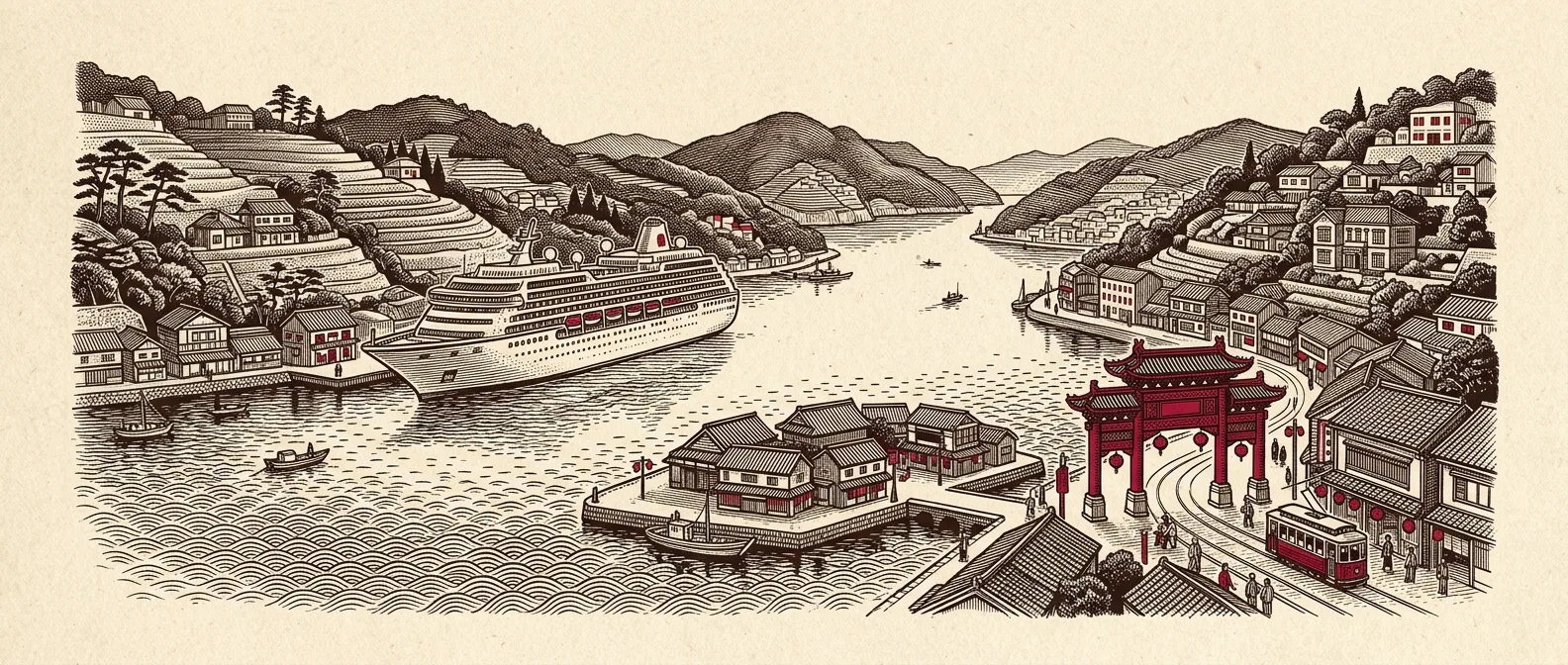
Nagasaki suits a short call better than most Japanese ports. The harbor sits close to the old foreign settlement, a tram line serves the area, and the main sights are within a short ride or walk of each other.
Nagasaki rewards an independent, tram-based day: the main sights are close to the terminal, the flat tram fare is 150 yen, and the city's own walking itinerary from the port covers a lot in five hours. Two stops need planning: the Atomic Bomb Museum and Peace Park, which deserve unhurried time, and the Hashima (Gunkanjima) boat tour, which needs a booking and has sailing windows of 1.5 to 3 hours 10 minutes.
I haven't sailed into Nagasaki myself, so this guide gives published facts, each attributed and checked on 21 October 2026. Where sources disagree on a price or an hour, I say so rather than choosing one.
Key Takeaways
- Nagasaki had 198 cruise calls in 2025, fourth in Japan, and 194 of them were foreign-operated, the most of any port in the country (MLIT).
- Matsugae International Terminal is the main berth for large ships. MLIT's access note says to take tram Line 5 to Ourakaigan-dori and walk about 5 minutes, and lists a Nagasaki Bus stop for Glover Garden a 1-minute walk away.
- The Nagasaki Electric Tramway has a flat fare of 150 yen for adults and a one-day pass for 600 yen.
- Dejima is open 8:00 to 21:00 for 1,100 yen. The Atomic Bomb Museum is open 8:30 to 17:30 for 200 yen, and the National Peace Memorial Hall is free.
- Hashima tour sailing windows run 1.5 to 3 hours 10 minutes depending on the operator, tours need advance booking, and landing can be refused even in calm weather.
Where the Ship Docks
Two terminals serve cruise ships: the Matsugae International Terminal and the Dejima Wharf. I could not confirm the walking distance between them. MLIT lists Matsugae with Japan's largest-class customs and immigration facilities (MLIT). The terminal building is at 7-16 Matsugae-machi and is open 9:00 to 18:00, closed Saturdays, Sundays and holidays (Discover Nagasaki).
Reports say Matsugae handles the largest ships and Dejima smaller ones, but I could not confirm the allocation per call, and reported dimensions conflict, so I'm not quoting berth lengths. I could not confirm a "new Nagasaki Port terminal." I found only a planned extension that would let two 160,000-ton ships berth at once at Matsugae.
Nagasaki is also one of Japan's busiest cruise ports, so expect other ships' passengers at the main sights. I found no crowd data.
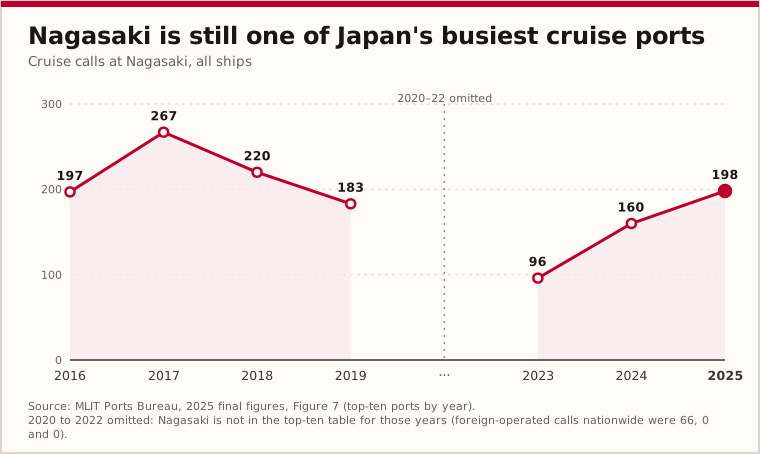
In 2025, Nagasaki had 198 total calls and 194 foreign-operated, which was the highest foreign-operated count in Japan, ahead of Hakata at 191 and Naha at 187 (MLIT).
The Tram Day
Nagasaki's trams cost a flat 150 yen for adults and 80 yen for children, with a cashless short-hop fare of 110 yen. A one-day pass is 600 yen for adults and 300 yen for children (Nagasaki Electric Tramway). Some older sites still quote 140 yen or a 500 yen pass.
MLIT's access note for the terminal says to take tram Line 5 to the Ourakaigan-dori stop and then walk about 5 minutes, and it lists a Nagasaki Bus stop for Glover Garden a 1-minute walk away (MLIT). It does not say which start point each walk is measured from, so confirm on a map.
The official walking itinerary
Discover Nagasaki publishes a 5-hour itinerary from the port (Discover Nagasaki):
- Glover Garden, about a 10-minute walk from the port by Discover Nagasaki's figure (MLIT's tram-plus-walk route above differs).
- The Confucian Shrine and the Historical Museum of China, about a 10-minute walk further.
- Suwa Shrine, by tram (about 20 minutes) and a 10-minute walk.
- Back to Matsugae by tram, about 20 minutes plus a 5-minute walk.
That route covers the foreign-settlement sights. Adding two or more hours for the Atomic Bomb Museum and Peace Park makes a tram day of roughly seven hours by my arithmetic, so on an 8-hour window pick the foreign-settlement route or the Peace Park route, not both.
What to See, With Hours
All hours below are from the named source unless noted, and several sights close early in winter, so check your date.
| Sight | Hours | Admission | Source |
|---|---|---|---|
| Glover Garden | 8:00 to 18:00, last entry 17:40 | 620 or 1,300 yen depending on the page, so check | Discover Nagasaki |
| Dejima | 8:00 to 21:00, entry closes 20:40 | 1,100 yen adults, 550 students | Dejima |
| Atomic Bomb Museum | 8:30 to 17:30, last entry 17:00 (later in summer) | 200 yen | Discover Nagasaki |
| National Peace Memorial Hall | 8:30 to 17:30 (later in summer) | free | Discover Nagasaki |
| Sofukuji | 8:00 to 17:00 | 500 yen | Nagasaki Tourism |
| Oura Church | about 8:00 or 8:30 to 18:00, sources differ | 1,000 yen, includes the Christian Museum | Nagasaki Tourism |
| Megane Bridge | outdoors | no admission found | Nagasaki Tourism |
Glover Garden's price is the clearest example of why I'm cautious. Discover Nagasaki's page shows 1,300 yen, another Nagasaki tourism page lists 620 yen, and older sites also quote 620 yen. Dejima's own site lists theater suspensions on some dates in October 2026, so check its calendar if the show matters to you.
The Atomic Bomb Museum and Peace Park
The Atomic Bomb Museum and the National Peace Memorial Hall are the city's heart, and they deserve a slow visit, not a stop on the way to lunch. Give them at least two hours, and check the closing times: the museum's last entry is at 17:00 outside summer.
Hashima (Gunkanjima) From a Cruise Call
The abandoned island of Hashima is one of Nagasaki's best-known trips, but it is also the one that most often does not work out. Five operators run landing tours from different terminals, with 1.5 to 3 hours 10 minutes of sailing time.
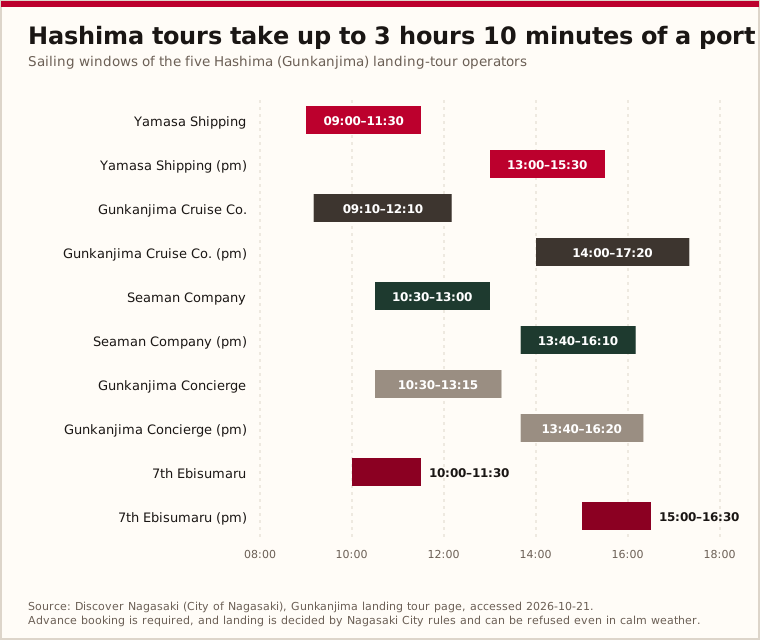
All of the sailing windows come from Discover Nagasaki's official page (Discover Nagasaki). Advance reservations are required. Landing is decided under Nagasaki City rules and may be refused even in calm weather. There are no toilets, shops or vending machines on the island, and umbrellas, heels and sandals are banned.
Secondary reports are more cautious about the landing. A January 2026 review mentioned about 30 minutes of net landing time, and an October 2025 review said a typhoon had damaged the pier, so no landing was possible. I found no official cancellation rate.
If your call is short, even the shortest 1.5-hour sailing takes a large part of it. If your ship sells a Hashima excursion, note that Princess and Celebrity say the ship waits for tours booked through them, which independent bookings don't carry (check your line's terms). See ship excursions vs. exploring independently.
What to Eat: The Story of Nagasaki on a Plate
Nagasaki's food reflects centuries as Japan's window to China and Europe, and a few dishes are worth a place in your day.
Champon and sara udon. Both date to the Meiji era, and the Japanese government's publication credits champon to Chen Ping Shun of the Chinese restaurant Shikairo, who made it for poor Chinese students, with sara udon also said to have originated there (Government of Japan). Sources disagree on whether Shikairo opened in 1899 or 1902 (JEEPE).
Castella. Nagasaki's tourism site describes the Portuguese-origin sponge cake as more than 400 years old, and says the shop Fukusaya has made it since 1624 (Nagasaki Tourism).
Turkish rice. A pork cutlet with demi-glace on pilaf, with spaghetti and a salad. It has no link to Turkey, nobody is sure where the name comes from, and nearly 100 places in Nagasaki City serve it, according to JNTO (JNTO).
For broader background on the dishes you will meet, the Japanese food guide covers etiquette and basics.
Pitfalls
- Closing times. Last entry at the Atomic Bomb Museum is at 17:00 outside the summer extension.
- Conflicting prices and hours. Glover Garden and Oura Church show different figures on different official pages, so confirm on the day.
- Hashima's weather risk. A booked tour may not land.
Frequently Asked Questions
Can I visit Nagasaki independently on a cruise?
Yes. It is one of the best ports for it, because the tram runs from near the terminal to most sights for a flat 150 yen.
How much time do I need for the Atomic Bomb Museum?
Plan at least two hours for the museum and memorial hall together. The museum's last entry is at 17:00 outside the summer extension.
Is Hashima worth it on a cruise call?
It is the most memorable option and the least reliable. Its sailing windows run 1.5 to 3 hours 10 minutes, it needs advance booking, and landing can be refused. Princess and Celebrity say the ship waits for tours booked through them, and independent bookings don't carry that, so check your line's terms.
The Bottom Line
Do Nagasaki by tram, give the Peace Park real time, and treat Hashima as an either-or choice that costs a big share of your day. For other Kyushu and western Japan ports, see the Hiroshima guide and the Kagoshima guide, and for the full set the Japan cruise ports guide.