Osaka & Kobe Cruise Port Guide: Getting to Kyoto on Your Own
Osaka and Kobe cruise port guide: which berth you use, Kyoto and Nara by train, sourced fares and hours, and where to eat Kobe beef.
Osaka and Kobe are the ports where a Japan cruise passenger most often has to decide how to get to Kyoto. The ship docks at a city that is worth a day on its own, and the one place everyone wants to see is a train ride away. A ship excursion solves that in one purchase. Doing it yourself costs a fraction as much and takes some planning.
By my arithmetic you can do Kyoto on your own from either port on a call of nine hours or more, but only if you commit to one or two sights and treat the return train as the deadline. From Kobe, Sannomiya to Kyoto takes about 52 minutes on the JR Special Rapid, plus the 5-minute Port Liner. From Osaka, the train is about 29 minutes, but you first need about 23 minutes of metro from Tempozan to Umeda, so both ports are roughly an hour each way. If your call is shorter, or you'd rather not gamble on the clock, stay in Osaka or Kobe and eat.
I haven't sailed into either port, so this guide gives the published numbers with a source beside each, checked on 21 October 2026. Rail and metro fares come from journey planners, which are close but not official, so confirm on the day.
Key Takeaways
- Kobe had 142 cruise calls in 2025 and Osaka 83 (MLIT).
- From Kobe Port Terminal, the Port Liner reaches Sannomiya in about 5 minutes for 210 yen. From Sannomiya, the JR Special Rapid takes about 52 minutes to Kyoto (about 1,110 yen) or 21 minutes to Osaka Station (about 420 yen).
- From Osaka's Tempozan wharf, Osakako Station is about a 5-minute walk, and Osaka Station to Kyoto Station is about 29 minutes by Special Rapid (about 580 yen).
- Princess lists Kyoto excursions from $124.95 to $244.95 per person, so going independent can save a couple of hundred dollars for two.
- Kobe beef is defined by official rules: Tajima cattle, a meat quality score of 4 or above, and a marbling score (BMS) of 6 or above. A beef lunch typically costs 7,000 to 12,000 yen per person, according to Feel KOBE.
Osaka and Kobe at a Glance
Osaka and Kobe sit about 30 kilometers apart on the same bay, and with Yokohama and Tokyo they are the main cruise gateways on Honshu.
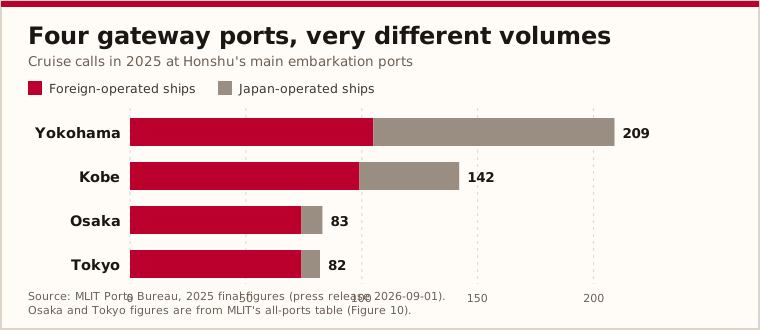
Kobe's 142 calls include 43 by Japan-operated ships, and Osaka's 83 include 9 (MLIT). Your call is more likely to be a Kobe call if you sail on a Japan-operated line.
Osaka: the Tempozan wharf
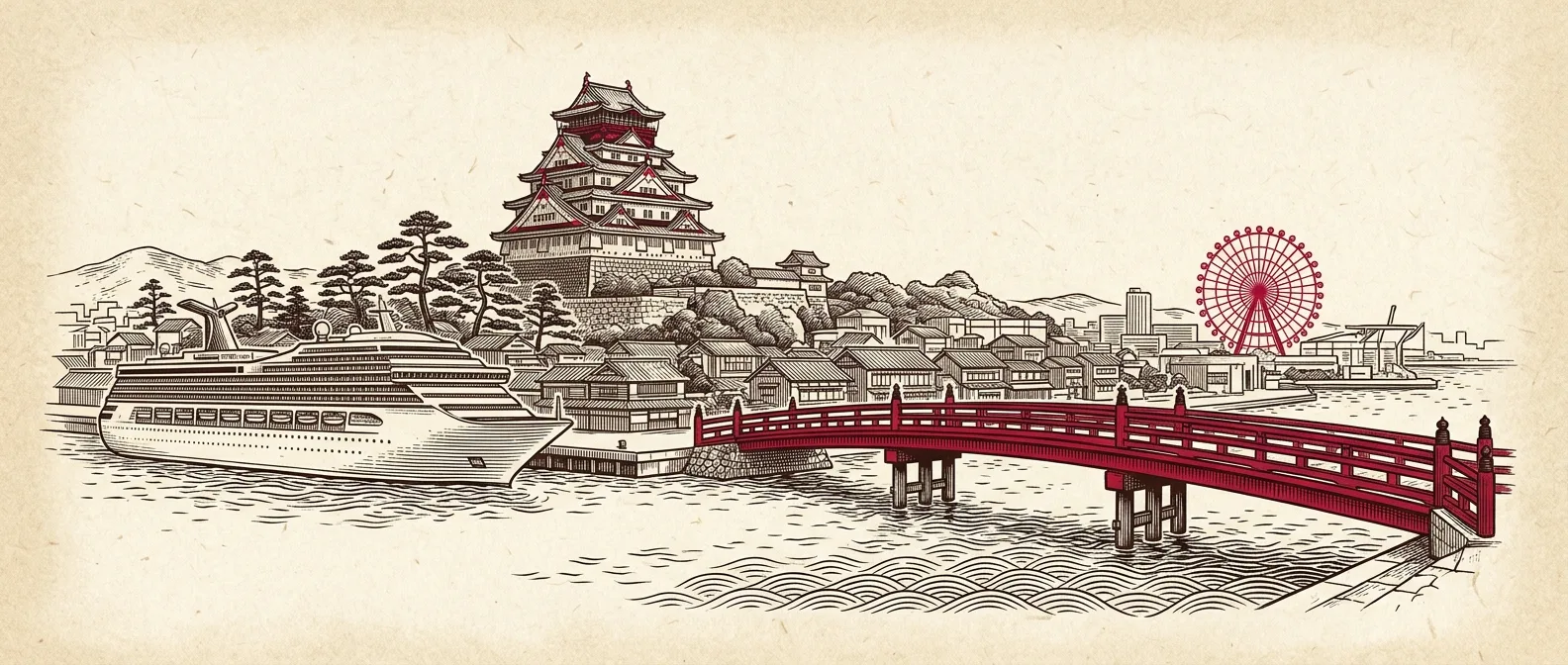
Ships at Osaka Port use the Tempozan wharf. The City of Osaka gives the walk to Osakako Station (Osaka Metro Chuo Line) as about 5 minutes, and a rebuilt passenger terminal reopened in May 2025 (City of Osaka, Cruise Industry News). The city also lists a boat to Universal Studios Japan, about 10 minutes.
From Osakako, Navitime shows these metro journeys (secondary, so confirm):
- To Honmachi (for Osaka Castle): 12 minutes on the Chuo Line, 240 yen.
- To Umeda: 23 minutes with one transfer, 290 yen.
- To Namba: 21 minutes with one transfer, 290 yen.
Tempozan has no direct rail line to Kyoto. You change from the Chuo Line to JR or Hankyu.
Kobe: Shinko Pier
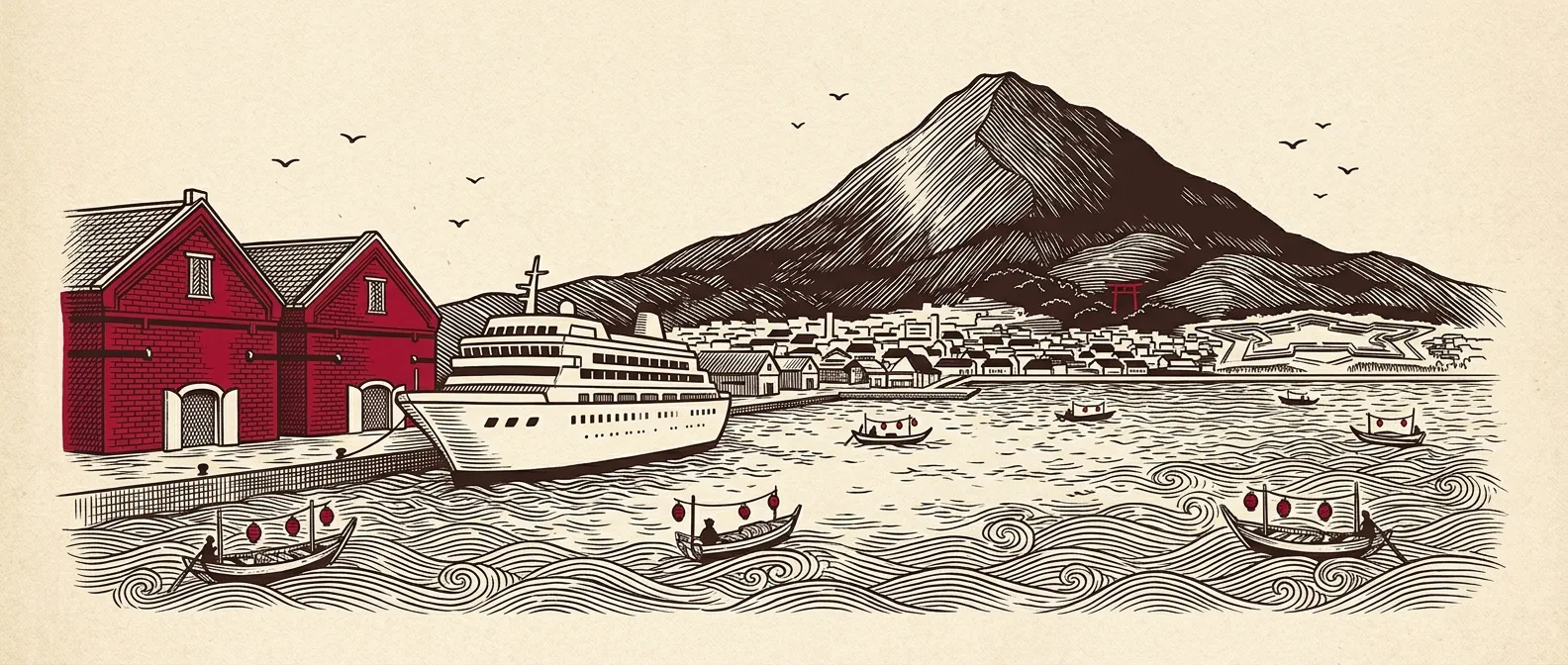
Kobe Port Terminal sits on Shinko Pier No. 4. It has two mobile boarding bridges, customs and immigration on site, and east berths totaling 649 meters and west berths totaling 491 meters (Kobe Port Meriken). Some ships use the Naka Pier terminal near Meriken Park instead, and Princess says your cruise documents show which terminal you are using (Princess Cruises).
From the terminal, the Port Liner to Sannomiya takes about 5 minutes and costs 210 yen. Door to door including the walk between Sannomiya's stations, Navitime puts it at about 13 to 14 minutes. IC cards such as ICOCA, Suica and PASMO work on the Port Liner, which is not covered by the JR Pass (Navitime and Kobe Station, both secondary).
Doing Kyoto on Your Own
This is the question most people have. The honest answer is that it works if your call is long enough and your plan is small.
The trains
All fares and times are from Navitime, a secondary source, so check JR West or a journey planner before relying on them.
| Route | Time | Fare |
|---|---|---|
| Osaka Station to Kyoto Station, Special Rapid | about 29 minutes | about 580 yen |
| Sannomiya to Kyoto Station, Special Rapid (direct) | about 52 minutes | about 1,110 yen |
| Sannomiya to Osaka Station, Special Rapid | about 21 minutes | about 420 yen |
JR West has no separate surcharge for the Special Rapid, and IC cards like ICOCA and Suica are accepted. Hankyu runs from Umeda to Kyoto-Kawaramachi in about 40 to 45 minutes for around 410 yen, according to Trip.com's transport guide.
For the total trip, Princess says Kobe to Kyoto typically takes about an hour and Osaka 20 to 30 minutes by train (Princess Cruises); that is a rail-only figure that leaves out the leg from the berth. I could not find an official door-to-door time from either berth to Kyoto. My own arithmetic: with about an hour each way, a 30-minute buffer, and some time moving between Kyoto sights, a call of nine to ten hours leaves roughly five and a half to six and a half hours at the sights, not seven or eight. That is my estimate, not a published figure.
Picking one or two sights
Pick the sights that are close to each other and check the closing times, because Kyoto's temples close early.
- Fushimi Inari. Secondary sources describe it as always open and free. It is the easiest to fit around a train timetable.
- Kiyomizu-dera. It opens at 6:00 and normally closes at 18:00, with 18:30 from 1 July to 13 August (Kiyomizu-dera). Japan-guide lists admission at 500 yen, but the temple's own pages I could reach don't state the regular fee, so confirm it.
- Kinkaku-ji. Open 9:00 to 17:00 with no closing days listed (Shokoku-ji). Japan-guide lists 500 yen, but a newer tourist-office sheet may show 700 yen, so check the fee before you go.
- Sanjusangendo. From 1 April 2026, 8:30 to 17:00 with last entry at 16:30. From 16 November to 31 March, 9:00 to 16:00 with last entry at 15:30 (Sanjusangendo). Admission is 600 yen for adults.
- Nijo Castle. The castle ticket is 800 yen for adults, and 1,300 yen with the Ninomaru Palace. Hours run from 08:45, and the castle closes at 17:00 with last entry at 16:00 (Nijo Castle).
That Sanjusangendo winter closing time of 16:00 is a good example of why the time budget guide tells you to check hours for your month of sailing.
If Kyoto's geisha district is on your mind, can you see geisha in Kyoto covers what visitors can realistically expect.
Cost against the ship excursion
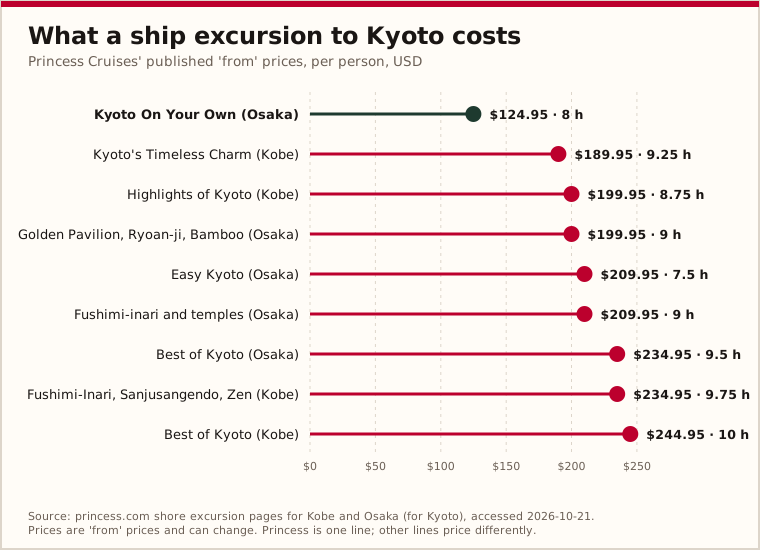
Princess's cheapest Kyoto option is "Kyoto On Your Own" at $124.95 for 8 hours. Its guided tours run from $189.95 to $244.95 (Princess, Osaka, Princess, Kobe). A day by train from Kobe, using the Navitime fare, is roughly 2,200 yen round trip for the JR leg, plus about 420 yen for the Port Liner and Kyoto entrance fees. The price gap is real. Princess says the ship waits for tours it sells, but its pages do not say whether that covers Kyoto On Your Own at $124.95, so confirm. What the guided tours add is a guide and a fixed route. See ship excursions vs. exploring independently.
Nara by Train
Nara is a smaller alternative to Kyoto and works well from Osaka. Kintetsu Namba to Kintetsu Nara by rapid express takes about 40 minutes for 680 yen, according to secondary sources.
From Kintetsu Nara Station, Todai-ji is about a 20-minute walk east along Noborioji-cho, and Nara Park is 5 to 10 minutes on foot (Todai-ji). The Daibutsu-den is open 7:30 to 17:30 from April to October and 8:00 to 17:00 from November to March, and admission is 800 yen. Kasuga Taisha's general worship hours are 6:30 to 17:30 from March to October and 7:00 to 17:00 from November to February (Kasuga Taisha). Deer crackers cost about 200 yen a bundle.
Staying in Osaka
If Kyoto feels like too much, Osaka is a fine day on its own.
Osaka Castle. The main keep (Tenshukaku) costs 1,200 yen for adults since 1 April 2025, and is open 9:00 to 18:00 with last entry at 17:30 (Osaka Castle). The park is always open and free. Many older guides still quote the 600 yen price, so don't trust anything dated before 2025.
Dotonbori and Kuromon Market. These are the main eating areas according to Osaka Info (Osaka Info). Osaka Tourism puts eight pieces of takoyaki at roughly 500 to 900 yen, and okonomiyaki at roughly 900 to 2,800 yen with many in the 1,000 to 1,500 range (secondary, so prices will have moved).
Staying in Kobe
Kobe is compact and suits a slow day.
Kobe beef. The Kobe Beef Marketing and Distribution Promotion Association defines it as beef from Tajima cattle raised and slaughtered in Hyogo, with a yield score of A or B, a meat quality score of 4 or above, a marbling score (BMS) of 6 or above, and a carcass weight within set limits (Kobe Beef Association). For how grading works more generally, see how wagyu is graded.
Prices vary widely by restaurant and cut, and dinner usually costs much more than lunch, so check the menu before you book. Book ahead where you can, and ask the restaurant about the grade.
Nunobiki Herb Garden. The ropeway plus garden ticket was 2,000 yen until March 2026 and is listed at 2,500 yen from April 2026 by the prefectural tourism board (Visit HYOGO). That is a published figure, not one I could confirm on the operator's own page, so check. Hours on a sample day in October are ropeway up from 9:30 to 16:45 and garden entry to 16:30, and the garden is closed 23 January to 12 February 2027 (Kobe Herb Garden).
Kitano Ijinkan. The Weathercock House is open 9:00 to 18:00, with last entry at 17:45, for 500 yen. It closes the first Tuesday of February and June (Visit HYOGO).
Kobe Chinatown (Nankinmachi). More than 100 shops and restaurants, with hours that vary by shop. It is about a 15-minute walk south from Sannomiya (Feel KOBE).
Pitfalls
- Wrong berth. Check whether you are at Kobe's Shinko Pier or Naka Pier, or Osaka's Tempozan, before you plan a route.
- A big ship at Kobe. Cruise Critic users report some large ships can't reach certain Shinko Pier berths because of a bridge limit. That is anecdotal, so just confirm the berth.
- Kyoto closing times. Temples close earlier than you expect in winter.
- Return buffer. Allow 30 minutes at the station on the way back.
Frequently Asked Questions
Can I visit Kyoto from the Osaka cruise port?
Yes, on a call of about nine hours or more. Osaka Station to Kyoto Station takes about 29 minutes on the Special Rapid, and it takes a metro ride to reach Osaka Station from the wharf first.
How far is the Kobe cruise terminal from Kyoto?
Princess says about an hour by train. From Sannomiya the JR Special Rapid takes about 52 minutes (Navitime), plus the 5-minute Port Liner ride and a walk between stations.
Is Kobe beef worth it on a short port day?
It is a good use of a lunch slot, and Kobe's compact center makes it easy to fit. Expect 7,000 to 12,000 yen per person at lunch.
The Bottom Line
Decide early whether your day is Kyoto or the port city itself. If it is Kyoto, take one or two sights and keep the return train as your deadline. If it is Osaka or Kobe, enjoy the food and walk. For the other end of a typical itinerary, see the Tokyo and Yokohama guide, and for the next ports west, the Hiroshima guide. The whole set is in the Japan cruise ports guide.