Best Time to Visit Japan: A Month-by-Month Guide (2026-2027)
Best time to visit Japan: late March to early April for cherry blossom, mid-November to early December for autumn leaves. Monthly weather, crowds and rain.
The best time to visit Japan for most people is late March to early April for cherry blossom, or mid-November to early December for autumn leaves (koyo). But the honest answer depends on what you want. Blossom, snow, festivals, hiking, low prices and cool weather all point to different months, and Japan's busiest and quietest months are closer together than you'd expect.
This guide gives you the numbers: monthly visitor counts from Japan's national tourism organisation, 30-year weather averages for Tokyo, Kyoto, Osaka, Sapporo and Naha, typical blossom and autumn dates, and the holiday weeks that fill trains and hotels in 2026 and 2027. Use it to decide when to visit Japan, then which region to base yourself in. It also covers the worst time to visit Japan, so you know what to avoid.
Key Takeaways
- Best overall: mid-November to early December. Tokyo's average highs are 16.7°C in November and 12.0°C in December, rain drops to 96 mm and 58 mm, and autumn colour peaks in Tokyo and Kyoto in that window.
- Best for cherry blossom: about March 25 to April 8 for Tokyo, Kyoto and Osaka. The 2026 blossom in Tokyo peaked on March 28, three days ahead of average, so book flexible.
- Japan is never really empty. In 2025, the busiest month (April, 3.91 million visitors) was only about 20% above the quietest (February, 3.26 million).
- Wettest, not best: October is the second-busiest month and Tokyo's wettest (235 mm). June is rainy season in most of Japan; Okinawa's wettest months are May, June and September.
- Avoid the holiday rushes if you can: Golden Week (April 29 to May 5), Obon (mid-August) and New Year (around December 29 to January 3).
- Summer is hot. Kyoto averages a 33.7°C high in August. Hokkaido is the cool escape, with Sapporo at 26.4°C.
The Short Answer: Best Time to Visit Japan by Goal
| If you want | Best window | Watch out for |
|---|---|---|
| Cherry blossom | Late March to early April (Tokyo, Kyoto, Osaka); mid-April to early May (Tohoku, Hokkaido) | Peak crowds; bloom dates shift by a week or more |
| Autumn colour | Late October (Sapporo); mid-November to early December (Kyoto, Tokyo) | Kyoto hotel rates are among the highest in November |
| Fewer people, cold but dry | Late February to early March | Cold mornings; blossom not yet open |
| Skiing and snow | January to February (December to April overall) | Christmas, New Year and early February are busiest |
| Cool summer | July to August in Hokkaido | Typhoon season starts across the south |
| Hiking Mt. Fuji | July 1 to September 10 (Yoshida trail, 2026 dates) | Climbing fee and daily cap |
| Okinawa in winter | November to April for the lowest rain and typhoon risk (mild, not swimming weather) | May and June are very wet in Okinawa |
| Lowest crowds on the numbers | February and September | February is cold; September is typhoon season |
Japan's Year at a Glance
Most "best time" questions come down to a handful of seasonal windows that overlap. The chart below puts them on one calendar.
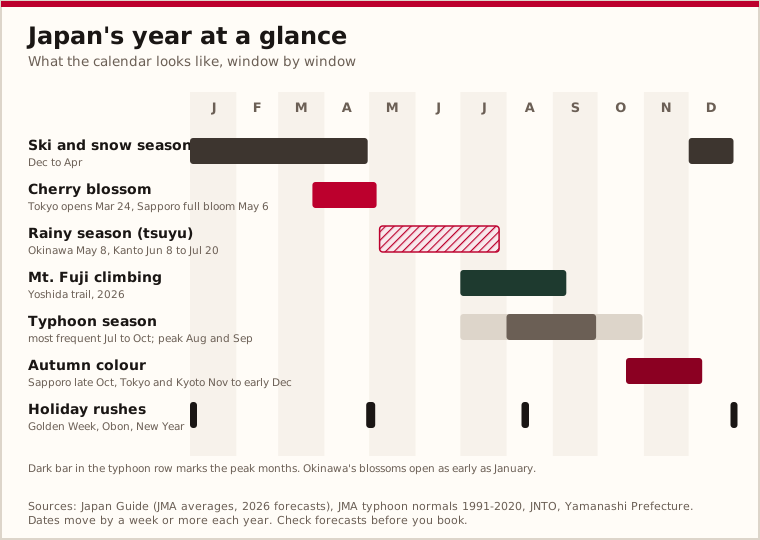
Two things stand out. Spring and November are the stretches with the fewest weather problems, which is why everyone wants them. And blossom lasts only days and peak colour a couple of weeks in any one place, so a fixed itinerary can miss them by a few days either way.
When Is Japan Busiest? Crowd Data by Month
Japan welcomed 42,683,301 international visitors in 2025, a record and 15.8% more than 2024's 36.87 million, according to JNTO figures reported by Travel Voice. The monthly pattern is flatter than most travel advice suggests.
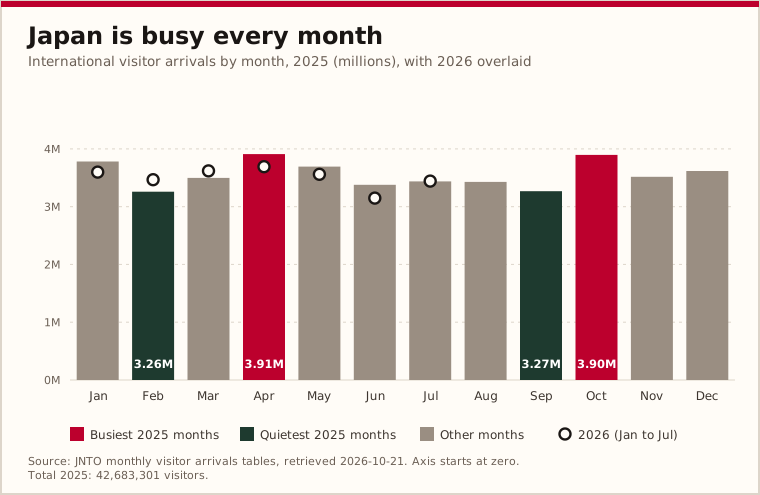
April (3.91 million) and October (3.90 million) were the busiest months of 2025, and February (3.26 million) and September (3.27 million) were the quietest, per the JNTO monthly table. The gap between the busiest and quietest month is about 20%. There is no true off-season. What changes is where the crowds go: nationwide totals include Tokyo-bound business and city travel all year, while blossom and colour concentrate visitors into a few famous places for a few weeks.
A note on 2026. Arrivals so far are slightly below 2025's record. JNTO reports 24,527,200 visitors for January to July 2026, down 1.7%, with Chinese arrivals down sharply (July: 428,200, down 56.1%). JNTO's 2026 monthly table puts its preliminary estimates for August and September 2026 below the same months in 2025. Don't read that as "empty": the popular spring and autumn weeks remain the hardest to book.
Japanese holidays that fill trains and hotels
Domestic holiday weeks are a bigger planning issue than foreign tourist numbers. Dates below come from the Cabinet Office national holiday list.
| Holiday period | 2026 | 2027 | Notes |
|---|---|---|---|
| Golden Week | Apr 29 (Wed), May 3 to 5, May 6 (substitute holiday) | Apr 29 (Thu), May 3 to 5 | Many Japanese take Apr 30 and May 1 off to bridge, so expect the longest queues |
| Mountain Day / Obon | Aug 11 (Tue) | Aug 11 (Wed) | Obon is conventionally around Aug 13 to 16 but is not an official holiday |
| Silver Week | Sep 19 to 23 (Respect for the Aged Day Sep 21, Citizens' Holiday Sep 22, Autumnal Equinox Sep 23) | Sep 20 and Sep 23 only | In 2027 Sep 21 and 22 are ordinary days, so there is no five-day block |
| Year-end and New Year | Around Dec 29 to Jan 3 | Around Dec 29 to Jan 3 | Many shops, restaurants and some attractions close; shrines are busiest |
Also useful: Spring Equinox Day on March 21, 2027 falls on a Sunday, so Monday March 22 is a substitute holiday, a long weekend right at the start of blossom season.
Japan Weather by Month: Temperature and Rain
Japan stretches roughly 3,000 km from Hokkaido to Okinawa, so "the weather in Japan" is really four or five different climates. Here are average daily highs for four cities.
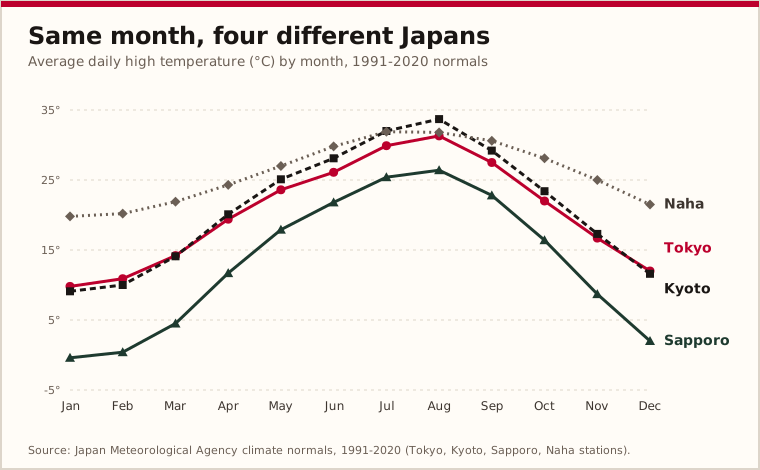
The numbers are JMA 1991-2020 climate normals. Sapporo in August (26.4°C) is about five degrees cooler than Tokyo (31.3°C) and seven cooler than Kyoto (33.7°C). Naha barely drops below 20°C even in January (19.8°C high), which is why Okinawa works as a winter escape.
Rain is where the seasons really split. This heat map shows average monthly precipitation for five cities.
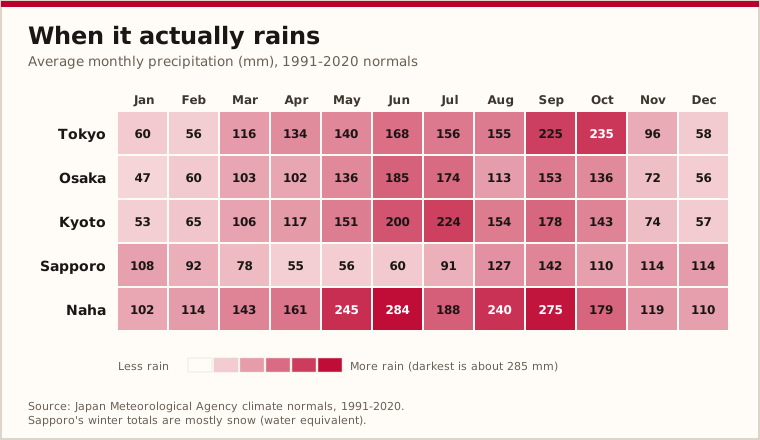
The surprise is October. In Tokyo it averages 235 mm of rain, nearly four times January's 60 mm, and it is the city's wettest month, ahead of the June rainy season (168 mm). Typhoons and autumn rain fronts explain it. October is also the second-busiest month for visitors. If you're picking autumn, November has far better odds: Tokyo gets 96 mm and a 16.7°C high.
Rainy season (tsuyu)
The rainy season starts in Okinawa in early May and moves up the islands over the next month. Per Japan Guide's JMA-based averages, Kanto (Tokyo) runs roughly June 8 to July 20.
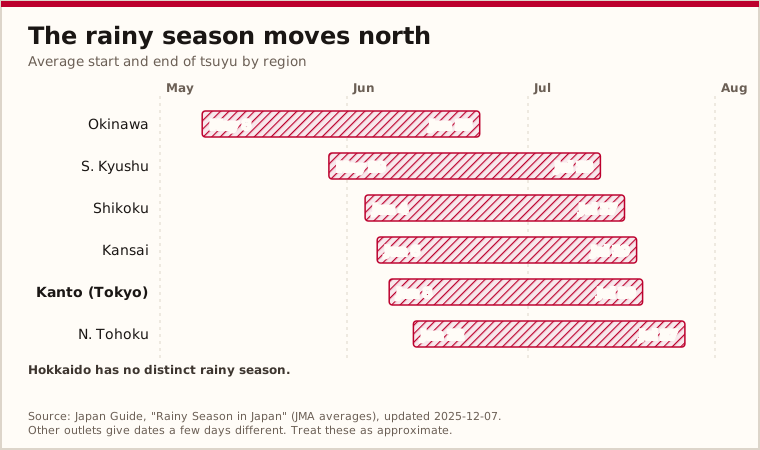
Other outlets quote dates a few days different, so treat these as approximate. Tsuyu isn't a month of non-stop downpours. It's grey, humid weather with frequent rain, and it's the cheapest, quietest stretch for city sightseeing. Hokkaido has no distinct rainy season, which makes June a good month to head north.
Typhoon season
Typhoons can occur from July through October. According to JMA's 1991-2020 statistics, about 25.1 typhoons form each year, 11.7 approach Japan and 3.0 make landfall. August and September each average about 3.3 approaches. Okinawa and Amami get more than the mainland (7.9 approaches a year against 5.8).
A typhoon rarely ruins a whole trip, but it can cancel a day of flights, shinkansen or ferries. If you travel between August and October, keep one flexible day, avoid tight international connections and buy insurance that covers weather disruption.
Summer heat
Summer is the hardest season on the body. JMA's data, as reported by Nippon.com, put summer 2026 at 1.02°C above the 1991-2020 average, the fifth hottest since records began in 1898, with 7,528 station-days at 35°C or above by August 31. Summer 2025 ran 2.36°C above average. JMA also introduced the term kokushobi in 2026 for days of 40°C or more (Nippon.com).
If you travel in July or August, plan outdoor sightseeing before 11 a.m., use museums and department stores in the afternoon, and carry water. Or go north to Hokkaido or up into the mountains.
Month by Month: What Each Month in Japan Is Like
The best time to go to Japan changes with each month's weather, crowds and events. This table shows the whole year at once. Tokyo figures are JMA 1991-2020 averages (daily high and low), and visitor counts are JNTO's 2025 arrivals.
| Month | Tokyo high / low | Tokyo rain | Visitors 2025 | Best for |
|---|---|---|---|---|
| Jan | 9.8 / 1.2°C | 60 mm | 3.78M | Skiing, onsen |
| Feb | 10.9 / 2.1°C | 56 mm | 3.26M | Snow festivals, low crowds |
| Mar | 14.2 / 5.0°C | 116 mm | 3.50M | Early blossom |
| Apr | 19.4 / 9.8°C | 134 mm | 3.91M | Peak blossom |
| May | 23.6 / 14.6°C | 140 mm | 3.69M | Tohoku and Hokkaido blossom |
| Jun | 26.1 / 18.5°C | 168 mm | 3.38M | Hokkaido, quiet city trips |
| Jul | 29.9 / 22.4°C | 156 mm | 3.44M | Mt. Fuji, festivals |
| Aug | 31.3 / 23.5°C | 155 mm | 3.43M | Hokkaido, festivals |
| Sep | 27.5 / 20.3°C | 225 mm | 3.27M | Value (typhoon risk) |
| Oct | 22.0 / 14.8°C | 235 mm | 3.90M | Hokkaido and Tohoku colour |
| Nov | 16.7 / 8.8°C | 96 mm | 3.52M | Autumn leaves, mild weather |
| Dec | 12.0 / 3.8°C | 58 mm | 3.62M | Early-December colour, ski start |
January
Cold, dry and bright in Tokyo (9.8°C high, 1.2°C low, 60 mm of rain). Ski season is in full swing and Sapporo averages -0.4°C. Visitors: 3.78 million, higher than you'd expect. Many shops and restaurants close around New Year, and shrines are packed. Okinawa's cherry blossoms can open as early as January, according to Japan Guide. Best for: skiing, onsen, Okinawa.
February
The quietest month of 2025 (3.26 million visitors) and one of the driest (Tokyo: 10.9°C high, 56 mm). Skiing is at its peak. The 2027 Sapporo Snow Festival runs February 4 to 11. Best for: value, snow, winter festivals. It's cold, so pack layers.
March
Warming up (Tokyo 14.2°C high, 116 mm of rain) as the first blossom opens. Tokyo's average first bloom is March 24, and full bloom March 31 (Japan Guide). Visitors: 3.50 million. Book accommodation early. In 2027, GREEN×EXPO in Yokohama opens March 19 and runs to September 26 (Highlighting Japan). Best for: early blossom (late month).
April
The busiest month of 2025 (3.91 million visitors) and the peak of cherry blossom. Tokyo is 19.4°C with 134 mm of rain. Kyoto and Osaka's average full bloom is April 4; Sendai's is April 13. Golden Week starts April 29. Best for: blossom, mild weather. Watch for: crowds, high prices.
May
Warm (23.6°C high in Tokyo) and green. Golden Week (May 3 to 5) crowds hit everywhere, then thin out. Sapporo's average full bloom is May 6. Okinawa's rainy season starts around May 8, and Naha averages 245 mm this month. Best for: Hokkaido and Tohoku blossom, post-Golden Week sightseeing.
June
Rainy season in most of Japan: Tokyo (26.1°C, 168 mm) from about June 8, Kyoto and Osaka (185 to 200 mm) from about June 6. Visitors: 3.38 million, among the lowest. Hokkaido stays dry (Sapporo: 21.8°C, 60 mm). Best for: quieter city sightseeing, Hokkaido.
July
Hot and humid: Tokyo is 29.9°C and Kyoto 32.0°C, with Kyoto's rain peaking at 224 mm as the rainy season ends. The Mt. Fuji climbing season opens July 1 (2026 dates). Visitors: 3.44 million. Best for: Mt. Fuji, summer festivals, Hokkaido.
August
The hottest month: Tokyo 31.3°C, Kyoto 33.7°C. Obon and Mountain Day (August 11) fill domestic transport. Typhoon risk is rising: about 3.3 approaches in the average year. Visitors: 3.43 million. Best for: festivals, Hokkaido's cool air. Not great for: long city walking days.
September
The quietest month after February (3.27 million visitors), and the wettest part of typhoon season (Tokyo: 225 mm, 27.5°C). The Fuji climbing season closes about September 10. In 2027, only September 20 and 23 are public holidays. Best for: value, if you accept some weather risk.
October
The second-busiest month (3.90 million) and, in Tokyo, the wettest (235 mm, 22.0°C high). Autumn colour begins in Hokkaido and mountain areas: Daisetsuzan peaked on September 17 in 2026, and Sapporo's colour arrives late October to early November (Japan Guide). Best for: Hokkaido and Tohoku colour, pleasant temperatures. Watch for: rain and crowds.
November
The sweet spot. Tokyo is 16.7°C with 96 mm of rain, and Kyoto's autumn colour arrives mid-November to early December. Visitors: 3.52 million. Kyoto hotels are among the priciest of the year: HotelBank's listed-price data shows Kyoto at ¥47,500 a night in November 2025 against ¥42,400 in April 2025 (the only months in that comparison). Best for: autumn colour, comfortable weather.
December
Crisp and dry (Tokyo 12.0°C, 58 mm). Tokyo's colour runs from late November to early December, with some trees holding into December. Ski areas open. The year-end shutdown begins around December 29. Visitors: 3.62 million. Best for: early-December colour, the start of ski season.
Cherry Blossom Season in Japan: Dates by City
JMA averages published by Japan Guide give these dates:
| City | Average first bloom | Average full bloom |
|---|---|---|
| Fukuoka | Mar 22 | Mar 31 |
| Tokyo | Mar 24 | Mar 31 |
| Kyoto | Mar 26 | Apr 4 |
| Osaka | Mar 27 | Apr 4 |
| Sendai | Apr 8 | Apr 13 |
| Hakodate | Apr 28 | May 2 |
| Sapporo | May 1 | May 6 |
Individual years swing by a week or more. In 2026, JMA declared Tokyo's first bloom on March 19 and full bloom on March 28, three days ahead of average, and AFP reported Kyoto's full bloom on March 30, against a pre-season forecast of April 1 or 2.
If you're planning blossom season at sea, our guide to the best time for a Japan cruise covers sailing windows. The practical lesson: don't lock in a single date. A good plan for 2027 covers March 25 to April 8, uses fully refundable bookings until forecasts firm up in the new year, and builds in a Plan B region. If Tokyo has finished blooming, a few days north in Tohoku or Hokkaido can still catch it. Japan Guide's 2026 viewing windows ranged from March 28 to April 4 in Tokyo to April 21 to 28 in Sapporo.
Autumn Leaves in Japan (Koyo): When to See Peak Colour
The leaves change from north to south, starting in Hokkaido's mountains in September. Japan Guide's forecast updated October 21, 2026 has Sapporo in late October to early November, Kyoto in mid-November to early December and Tokyo in late November to early December. An earlier Japan Meteorological Corporation forecast, reported by Time Out, had Tokyo's red maple around November 29 and ginkgo around November 26.
Autumn colour is more forgiving than blossom: it tends to last longer in any one place, and moving between regions extends your window. Starting in Hokkaido in late October and finishing in Kyoto in late November follows the colour south.
Winter: Snow, Skiing and Hokkaido
According to the Japan National Tourism Organization's ski guide, the ski season generally runs from December to April, with January and February at the peak and March warmer. The busiest times are Christmas, New Year and early February. Heavy snow comes from winds off the Sea of Japan, and well-known areas include Niseko in Hokkaido, Hakuba and Nozawa Onsen in Nagano, and Gala Yuzawa in Niigata, which is a day trip from Tokyo.
Tokyo's winter is dry: 56 to 60 mm of rain a month from December to February.
Best Time to Visit Japan by Region
| Region | Best months | Why | Avoid |
|---|---|---|---|
| Tokyo, Kyoto, Osaka | Late March to early April; mid-November to early December | Blossom and colour with moderate temperatures | June rain, August heat, October rain in Tokyo |
| Hokkaido | July to August; late October; January to February | Cooler summers and no rainy season; early colour; powder snow | Mid-winter if you dislike cold |
| Tohoku | Mid-April to early May; October | Later blossom (Sendai's average full bloom is April 13); colour | Cool late-April blossom days; mid-winter snow |
| Okinawa | November to April | Lowest rain (Naha 102 to 161 mm) and outside the typhoon peak | May and June (245 to 284 mm); August to October typhoons |
| Mt. Fuji (climbing) | July 1 to September 10 (2026 dates; check for 2027) | Official season on the Yoshida trail | Outside the season; the trail closes to climbers |
On Fuji, the official Yoshida trail information lists a ¥4,000 fee per climber and a daily cap of 4,000 climbers, and the season may be delayed by snow or weather.
What Timing Does to Your Budget
Peak months cost more, but the pattern isn't always spring. HotelBank's listed-price data (a single source based on OTA listings, not actual transactions) shows Kyoto at ¥47,500 a night in November 2025, ¥42,400 in April, ¥36,600 in August and ¥35,100 in July. Spring 2026 was higher still: Kyoto April rates were up 18.6% and May up 20.4% on 2025.
Two other costs to check:
- Kyoto accommodation tax. Since March 1, 2026, Kyoto's accommodation tax per person per night ranges from ¥200 (rooms under ¥6,000) to ¥10,000 (rooms of ¥100,000 or more), with ¥1,000 for rooms of ¥20,000 to ¥49,999.
- JR Pass. The Japan Rail Pass price rose on October 1, 2026. JNTO lists the ordinary 7-day pass at ¥53,000 (up from ¥50,000), the 14-day at ¥84,000 and the 21-day at ¥105,000. JNTO notes the official site may keep the old prices for a limited time, so check before buying. Whether a pass pays off depends on your route, not your month.
Flight prices vary too much by route and booking date for a month-level rule, so use a fare calendar on your own dates.
Planning From India: Visa and Timing
Travelling from another country? Visa rules depend on your passport, so check the Japanese embassy or foreign ministry page for your nationality. The rest of this guide applies wherever you're flying from.
Indian citizens need a visa for tourism in Japan. Business Today reported in April 2025 that Indian tourists can apply for a Japan e-visa; check the embassy for current eligibility and permitted stay. After the global fee revision on July 1, 2026, the visa fee for Indian applicants is reported as ₹500, with service charges extra. Confirm the current fee and rules with the Embassy of Japan in India before you pay anyone.
Apply well before your flights are non-refundable, and check the embassy's current processing times.
Choosing Your Dates: A Quick Decision Guide
- Pick your top priority. Blossom, colour, snow, festivals, hiking, or price. If you can only have one, that decides the month.
- Check your constraints. School holidays, leave, visa processing time. Then look at the holiday table above to avoid Golden Week, Obon and the New Year shutdown.
- Choose a flexible window, not a date. For blossom, March 25 to April 8. For colour, mid-November to early December.
- Match region to month. Hokkaido in summer, Okinawa in winter, Tokyo and Kyoto in spring and late autumn.
- Book refundable first. Fix flights once the blossom or colour forecasts firm up (Japan Guide's pages linked above are updated through the season).
- Leave a buffer day in typhoon season and a spare half-day in blossom season for weather.
Comparing ways to see Japan? Our Japan cruise planning guide and cruise vs independent travel cover the trade-offs. Planning meals around your trip? Browse our Japanese food guides.
FAQ
What is the best month to visit Japan?
November is the safest single month for weather. Tokyo averages 16.7°C with 96 mm of rain, autumn colour peaks in Kyoto from mid-November, and visitor numbers (3.52 million in 2025) are lower than April or October. If blossom matters more than anything, choose late March to early April.
What is the cheapest time to visit Japan?
On visitor numbers, February and September are the quietest months (3.26 and 3.27 million visitors in 2025). In Kyoto, listed hotel rates were lowest in July (¥35,100) and August (¥36,600) of the months in HotelBank's listed-price data. Cheaper months come with trade-offs: cold in February, typhoons in September, and heat in summer.
When is the rainy season in Japan?
Okinawa starts around May 8; Tokyo and Kanto around June 8 to July 20; Hokkaido has no distinct rainy season. Tokyo's wettest months are actually September (225 mm) and October (235 mm).
When is cherry blossom season in Japan?
Average full bloom is March 31 in Tokyo, April 4 in Kyoto and Osaka, and May 6 in Sapporo. It varies by a week or more each year. Plan for March 25 to April 8 for Tokyo, Kyoto and Osaka.
When is the best time to see autumn leaves in Japan?
Late October to early November in Sapporo, mid-November to early December in Kyoto, and late November to early December in Tokyo, per Japan Guide's October 2026 forecast.
Is August a bad time to visit Japan?
It's hot (Tokyo 31.3°C, Kyoto 33.7°C), crowded with domestic travellers during Obon, and sits in typhoon season. It's still a good month for festivals and for Hokkaido, where Sapporo averages 26.4°C.
Is Japan crowded in 2026 and 2027?
Japan recorded 42.68 million visitors in 2025. Arrivals for January to July 2026 were 1.7% lower, so 2026 is not far off last year's record pace. The famous places (Kyoto in November, Tokyo parks in blossom week) will still be crowded. For 2027, the pressure points are the same: Golden Week (April 29, then May 3 to 5), the long weekend around March 21, and the blossom and Kyoto autumn weeks. GREEN×EXPO in Yokohama (March 19 to September 26, 2027) may add domestic visitors. For fewer people, go early in the morning and choose weekdays.
How far ahead should I book?
For blossom and Kyoto in November, book flights and hotels as early as you can with free cancellation. There is no universal rule, but Japan's holiday weeks fill trains and hotels, so check the dates above first.
What is the worst time to visit Japan?
For crowds and prices, Golden Week (April 29 to May 5), Obon (around August 13 to 16) and the New Year shutdown (around December 29 to January 3) are the hardest weeks. For weather, the riskiest are the June rainy season on the main islands, August heat, and the typhoon peak in August and September. Okinawa is wettest in May and June.
Is it better to visit Japan in spring or autumn?
Both are good times to visit Japan. Spring brings cherry blossom and the busiest month of the year (April, 3.91 million visitors), but its dates are hard to predict. Autumn has longer, more forgiving colour windows and a mild November (Tokyo 16.7°C, 96 mm of rain), though Kyoto hotels are among the priciest then. October is wetter than it looks.
What is the best time to visit Tokyo or Kyoto?
Late March to early April for blossom and mid-November to early December for autumn leaves. Tokyo's average full bloom is March 31 and Kyoto's April 4. Avoid Kyoto in July and August (32.0 and 33.7°C highs) if you dislike heat.
Is Japan worth visiting in winter?
Yes, especially for snow, hot springs and low crowds. Ski season runs December to April, peaking in January and February, and Tokyo is dry (56 to 60 mm of rain a month) with highs around 10°C. Sapporo averages around freezing. Pack layers, and avoid Christmas, New Year and early February if you want quiet slopes.
When Should You Visit Japan? Final Verdict
The best time to visit Japan is when the season you want lines up with the crowds and weather you can live with. For most people, that means late March to early April or mid-November to early December, with the date flexibility to follow the blossom or the colour. If you want value, aim for February or September, and accept the cold or the typhoon risk. If you want cool air in summer, head to Hokkaido.
Whichever month you pick, keep your dates loose and your bookings refundable until the forecasts firm up, and let the data above make the call.
Sources and How This Guide Was Checked
All figures were retrieved on October 21, 2026. Visitor arrivals are from JNTO's monthly tables; the 2025 months add up to JNTO's printed annual total. Climate figures are JMA 1991-2020 normals. Blossom and autumn dates are Japan Guide averages and forecasts, and some 2026 events come from news reports, which are named in the text. Not covered, because no reliable sources were found: monthly rainy-day counts, snow monkey season dates and which month has the cheapest flights. Dates and prices change, so check them before you book.