Japan Cruise vs. Independent Travel: Which Should You Choose?
Japan cruise vs independent travel compared across cost, planning effort, and depth so you can pick the trip style that actually fits how you travel.
Every few months I get a version of the same message: someone is choosing between a Japan cruise and booking their own trip, and they want me to just tell them which one is better. I can't, because the honest answer depends entirely on what kind of traveler you are. But I can tell you exactly what each option gives you and what it quietly takes away, because I've spent a year of my life doing the independent side of this equation in enormous detail.
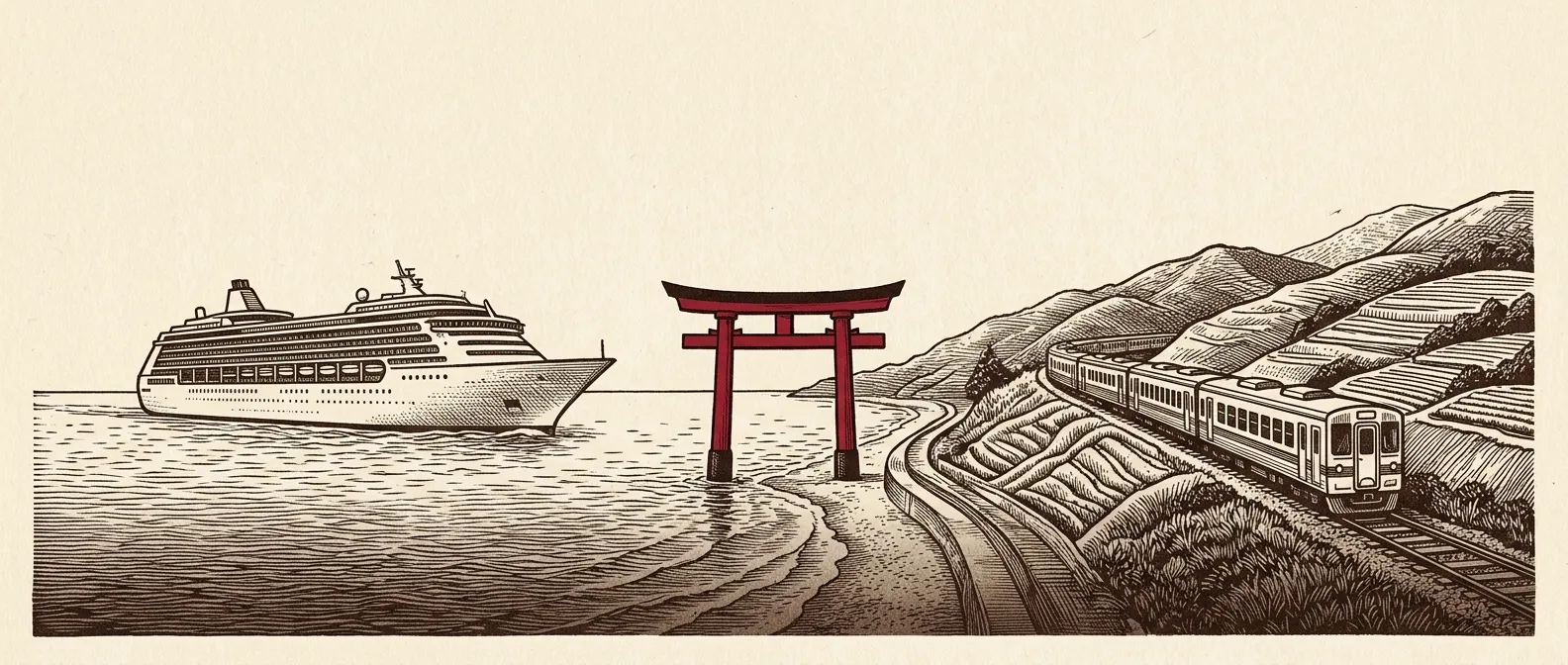
If you want to see a lot of Japan in a short window with almost none of the logistics, a cruise is the better fit. If you want to actually live inside a few places, even for a few days each, independent travel is the only way to get that. That's the real trade-off underneath every other comparison point in this post: breadth and ease versus depth and control. Neither choice is wrong. They're just answering different questions about what you want from the trip.
I should say upfront that I haven't personally taken a Japan cruise. What I know about that side comes from how the itineraries are structured, how port days work, and what past cruise travelers consistently report. Where I can speak with real specificity is the independent side, because I've booked every leg of a Japan trip myself, more than once, and I know exactly where that path gets hard and where it pays off.
Key Takeaways
- A cruise trades depth for breadth: you'll touch several regions in a short trip, but only for a few hours or a day at each stop.
- Independent travel trades ease for control: you plan every hotel, train, and meal yourself, but you can stay as long as you want anywhere you want.
- Cruises bundle accommodation, most meals, and transport between ports into one price; independent travel means separate bookings for each of those.
- The JR Pass and regional rail passes matter a lot for independent trips and matter almost not at all for cruises, since the ship handles inter-city movement.
- Neither option is objectively better. The right choice depends on how much planning you want to do and whether you'd rather sample widely or settle into fewer places.
Japan Cruise vs. Independent Travel: The Core Difference
The fundamental split between these two trip styles isn't price or comfort. It's how much of your itinerary is decided for you before you leave home.
On a cruise, someone else has already worked out the route, the port schedule, the onboard meals, and most of the transport. You show up, and the ship moves you from Kobe to Kagoshima to Busan to Nagasaki while you sleep. Your job is mostly to pick shore excursions and show up on time. That's a genuinely appealing proposition if planning stresses you out or if you simply don't have the hours to research train schedules and neighborhood restaurant options for eight different cities.
Independent travel puts every one of those decisions in your hands. You choose which cities, how many nights in each, which hotel, which train, and what you eat every single meal. That's more work, sometimes a lot more work, but it's also the only way to shape a trip around what you specifically care about rather than what fits into a fixed port schedule.
If you're still deciding whether a cruise fits your travel style at all before comparing it to the DIY route, our is a Japan cruise worth it breakdown looks at that question directly. It's separate from the independent-travel comparison.
What You Gain (and Lose) With a Japan Cruise
The Gains
A cruise removes almost all the friction of moving around a foreign country. You unpack once. Your meals are largely covered. You don't have to figure out which train platform you need in Osaka Station at 8am, because you're not taking a train at all. For a first-time visitor to Japan who feels intimidated by the idea of navigating a non-English-dominant transit system, that removal of friction is worth a real premium.
You also see more geography in less time than almost any independent itinerary would attempt. A single cruise might stop in ports across Kyushu, Honshu, and sometimes South Korea within a week or two, giving you a taste of regional variety that would otherwise take a much longer independent trip to replicate.
The Losses
The tradeoff is time on the ground. Shore excursions are typically measured in hours, not days. You might get six or eight hours in Nagasaki, enough for a curated highlight or two, but not enough to wander, get pleasantly lost, or come back the next morning because you liked the neighborhood. Depth is the first thing you give up.
You also lose control over pacing. If a port city turns out to be the best part of your trip, you can't simply extend your stay there. The ship leaves on schedule. And onboard dining, while often extensive, isn't the same as sitting at a six-seat counter in a shopping arcade watching a chef who's made the same dish for thirty years.
The ship size itself changes this equation too. A smaller ship can dock closer to city centers and add smaller ports to its route; a larger ship usually needs deeper harbors and tends to concentrate on bigger cities. If the scale of the ship matters to your decision, small ship vs. large ship Japan cruises goes into how that affects which ports you'll actually reach.
What You Gain (and Lose) With Independent Travel
The Gains
This is the side I know from experience, and the biggest gain is simple: you get to stay as long as something is working. When I spent a year traveling around Japan, some of my best days came from staying an extra night somewhere I hadn't planned to. A conversation with a shop owner or a particular meal made me want more time in that neighborhood. A fixed cruise schedule doesn't allow for that kind of improvisation. Independent travel does, by design.
You also get access to places a cruise itinerary will never include. Small mountain towns, single-street shopping arcades, a specific izakaya three train stops outside the tourist center, a ryokan in a hot spring town with six rooms total. None of that fits into a shore excursion. It only exists for travelers willing to book their own way there.
The Losses
The honest cost is effort. Every hotel is a separate booking. Every train is a decision, and if you're covering long distances, you'll need to work out whether a JR Pass makes sense for your route. The JR Pass is a rail pass sold by the JR Group of companies that gives unlimited travel on most JR trains nationwide for a fixed number of days. According to the official Japan Rail Pass site, it's priced by duration, and it only pays off if you're covering enough long-distance rail to offset the upfront cost, so a trip concentrated in one region often doesn't need one at all. You're responsible for language gaps, for figuring out where to eat, for knowing which neighborhoods are walkable and which require a taxi. Resources like the Japan National Tourism Organization site can help with some of that research, but the day-to-day planning work still falls on you. None of it is unmanageable, but all of it takes time before you ever board a plane.
There's also a stamina cost that people underestimate. Independent travel means you're the logistics manager of your own trip every single day. Some travelers find that energizing. Others find it exhausting by day ten. Know which one you are before you commit to three weeks of self-planned movement across the country.
Depth vs. Breadth: The Trade-Off That Actually Matters
Strip away the marketing language from both options and you're left with one real trade-off: do you want to see more of Japan, or do you want to know a smaller part of it better?
A cruise samples. In a single trip you might set foot in five or six port cities, each for a matter of hours. That's genuinely valuable if your goal is a broad first impression of the country, a way to figure out which regions you'd want to return to later for a longer, more focused trip.
Independent travel goes deep. Most people I'd recommend this to concentrate on two to four destinations and spend real days in each one. That's enough time to see a place change from morning to evening, to eat somewhere twice, to notice details a single afternoon visit never reveals. You cover less ground, but what you do cover, you actually know.
Neither approach is more legitimate than the other. A first-time visitor doing a broad cruise sampling tour and a returning visitor spending nine days in Kyoto alone are both traveling well. They're just optimizing for different things.
Planning Effort and Logistics, Side by Side
| Factor | Japan Cruise | Independent Travel |
|---|---|---|
| Cost structure | Mostly bundled (cabin, most meals, port-to-port transport) | Fully unbundled; every hotel, train, and meal booked separately |
| Planning effort | Low; itinerary largely fixed before departure | High; you plan every leg, including transport passes |
| Time per destination | Hours to one day per port | Typically 2+ nights per destination |
| Flexibility | Fixed schedule; can't extend a stop you love | Fully flexible; adjust pace as you go |
| Breadth of regions | Wide; multiple cities/regions in one trip | Narrower; usually 2-4 focus destinations |
| Transport logistics | Handled by the ship | Your responsibility (JR Pass, regional trains, local transit) |
| Best for | First-time visitors, low-planning travelers, broad sampling | Repeat visitors, travelers who want depth, food- or culture-focused trips |
| Worst for | Travelers who hate a fixed schedule or want to go off-script | Travelers who don't want to manage daily logistics |
For more detail on how to think through the trip-worth question before you even get to this comparison, the Japan cruise planning guide walks through the broader planning considerations. It covers everything from timing to route selection that sits underneath both options.
A Simple Decision Framework
If you're still torn, run your answer through these questions in order.
First, how much planning are you willing to do before you leave. If the idea of researching train routes and booking eight separate hotels sounds like a chore rather than part of the fun, that's a real signal toward a cruise. If you actually enjoy building an itinerary, independent travel will reward that.
Second, do you want breadth or depth on this specific trip. If you've never been to Japan and want a wide first look at multiple regions to figure out where you'd want to return, a cruise does that efficiently. If you already know you want to spend real time in Kyoto, or Kanazawa, or wherever it is, independent travel is the only way to get that.
Third, how do you feel about a fixed schedule. Cruises run on time. If a port city turns out to be extraordinary, you still leave when the ship leaves. If that thought bothers you even a little, lean independent.
Fourth, and honestly the most practical one: how much time do you have. A cruise can deliver a lot of geography in a week or two. An independent trip covering the same number of regions with real depth in each would take considerably longer. If your window is short and your ambitions are broad, the cruise math works in your favor.
The Bottom Line
There isn't a universally correct answer here, and anyone who tells you there is hasn't actually weighed both sides honestly. A cruise gives you ease, breadth, and a fixed schedule that removes almost all decision-making from your trip. Independent travel gives you depth, flexibility, and full control, at the cost of doing all that planning yourself.
Know which trade-off you're actually willing to live with, and the choice mostly makes itself. If you want help deciding whether a Japan cruise specifically makes sense for your travel style before comparing it further, start with our Japan cruise planning guide and go from there.