Japan Cruise Ports: The Complete Port-by-Port Guide
A guide to eight Japan cruise ports: 2025 call numbers, berth-to-town distances, seasonal opening hours and which port suits which traveler.
A Japan cruise is only as good as its ports, and the ports are very uneven. Some drop you a five-minute walk from a train station. Others leave you at a pier with no public transit and a long taxi ride to anything worth seeing. The brochure shows the same row of famous names, but the day you actually get ashore depends on the berth, the closing times and the commute.
Most Japan cruise itineraries use a handful of ports: Yokohama, Kobe or Osaka, Hiroshima, Nagasaki, Kagoshima, Hakodate, Otaru and Kanazawa. The easiest to do alone are Otaru, Kobe, Osaka, Nagasaki and Yokohama's Osanbashi pier. The ones that most often reward an excursion are Hiroshima's Miyajima and Kyoto from Osaka or Kobe. This guide is the map of those eight, not of all of Japan's ports (Hakata, Naha and several others fall outside the classic Circle Japan route), with a short verdict on each and a link to the full port guide.
I haven't sailed into these ports myself, so I'm not writing as a cruise veteran. I'm giving you the published facts, each with its source, checked on 21 October 2026: Japan's own national cruise statistics, port authority sheets, city tourism offices, operators' pages and the cruise lines' published prices. Where sources disagree or I couldn't verify something, I say so. Read them as a planning starting point, and confirm anything that decides your day with your own ship.
Key Takeaways
- Japan had 3,116 cruise calls in 2025, above its previous peak of 2,930 in 2018, and 1.77 million foreign visitors arrived by cruise (MLIT).
- Yokohama was the busiest port with 209 calls, followed by Hakata (208), Naha (205), Nagasaki (198) and Kobe (142). Of the other ports in this guide, Kagoshima had 129 and Hiroshima 106.
- Berth distance varies from about 5 minutes on foot (Osaka, Yokohama Osanbashi) to about 60 minutes from the sight (Hiroshima's Ujina to Itsukushima Shrine).
- Premium, luxury and expedition ships made 59% of foreign-operated calls in 2025, up from 47% in 2019.
- A port day is a window: subtract two commutes and a 30-minute buffer from the time between arrival and all-aboard, and plan to that number.
Why Japan's Ports Matter Right Now
Japan's cruise market has more than recovered. MLIT's final 2025 figures count 3,116 calls, 2,353 by foreign-operated ships and 763 by Japan-operated ships, at 94 ports that received foreign cruise ships (MLIT).
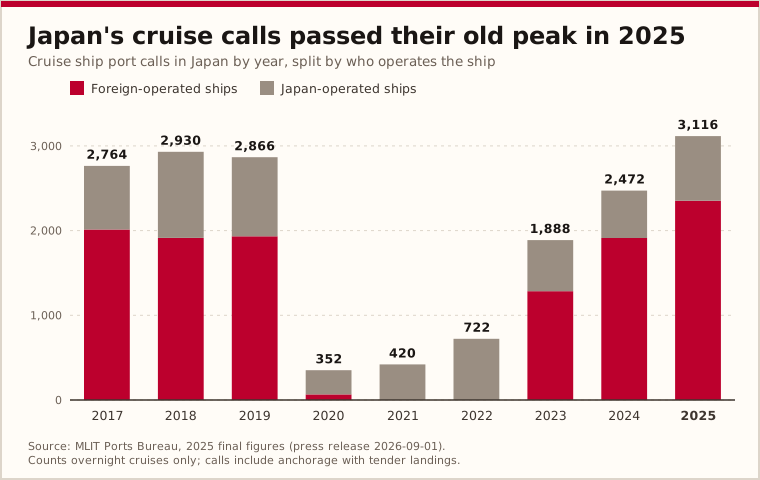
Inbound cruise passengers reached 1.772 million in 2025, about 70% of the 2017 peak of 2.53 million. The government's targets were 2.5 million passengers, more than 2,000 foreign-line calls and 100 ports, and calls beat their target while passengers and ports did not. A record 181,000 foreigners flew into Japan to join a cruise there (MLIT).
The mix has also changed. Premium, luxury and expedition ships made 1,378 of 2,353 foreign-operated calls in 2025, about 59%, compared with 907 of 1,932 in 2019, about 47%.
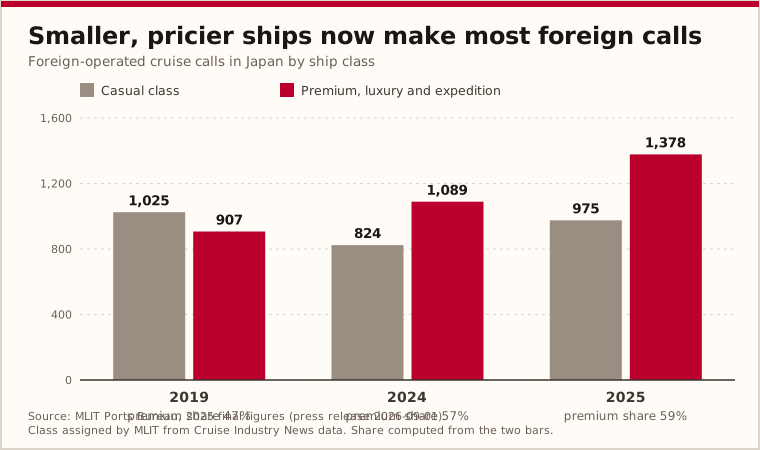
That matters for ports because smaller ships reach places big ones can't. If you are choosing between a mainstream and a small-ship line, the small ship vs. large ship comparison goes into detail.
The ten busiest ports
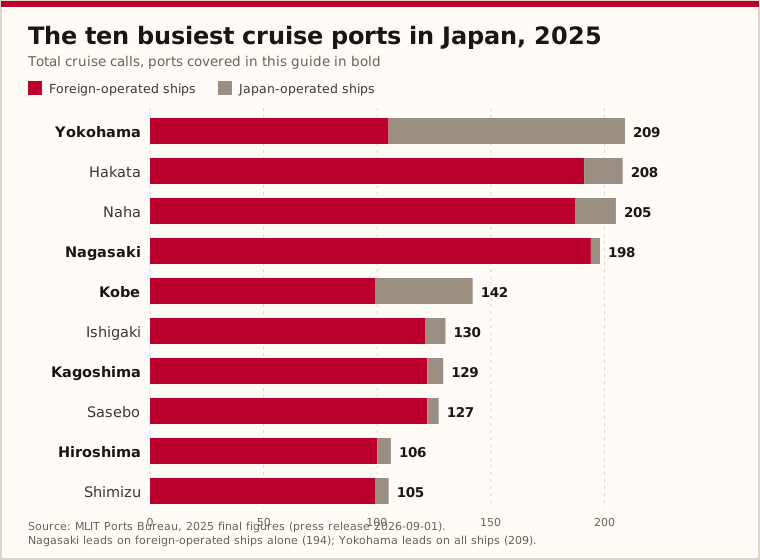
A note on rankings, because press stories disagree. On all ships, Yokohama is first with 209 and Hakata second with 208. On foreign-operated ships alone, Nagasaki is first with 194. Early figures from February had Yokohama and Hakata tied at 209, but the final September numbers separate them. I use the final numbers.
Five of the ten are covered in this guide, and most of the rest are Kyushu and Okinawa ports that sit outside the classic "Circle Japan" route.
The Ports at a Glance
| Port | 2025 calls | Berth to town | Best for | Guide |
|---|---|---|---|---|
| Yokohama | 209 | Osanbashi: 5 to 7 minutes' walk to Nihon-odori Station. Daikoku: taxi only | Tokyo, Kamakura, Chinatown | Tokyo guide |
| Kobe and Osaka | 142 and 83 | Kobe: Port Liner to Sannomiya in about 5 minutes. Osaka: about 5 minutes' walk to Osakako Station | Kyoto, Nara, Kobe beef, Osaka food | Osaka guide |
| Hiroshima | 106 | About 7 km, 20 minutes by the pier sheet (streetcar 29 to 50), shuttle required | The Peace Park or Miyajima | Hiroshima guide |
| Nagasaki | 198 | Tram line near the terminal | A tram day, the Peace Park, Hashima | Nagasaki guide |
| Kagoshima | 129 | Several kilometers, shuttle or taxi | Sakurajima, Sengan-en | Kagoshima guide |
| Hakodate | 75 | Shuttle bus to downtown per MLIT | Morning Market, a night view | Hakodate guide |
| Otaru | 33 | About 15 minutes' walk to the station | Canal, glass, sushi | Otaru guide |
| Kanazawa | 51 | About 30 minutes by local bus | Kenrokuen, teahouse district | Kanazawa guide |
The table's most useful column is the third. Here it is as a picture.
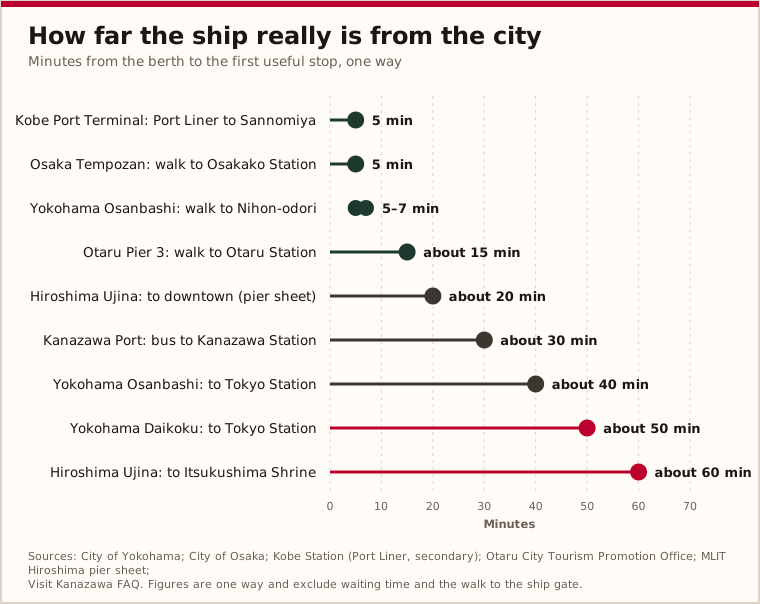
These are one-way figures from city, port and tourism-office sources, and they leave out waiting and the walk to the ship gate. A short number doesn't make a better port, but it makes an easier one.
Port by Port
Yokohama and Tokyo
Most Tokyo-bound ships dock at Yokohama, and which pier they use decides the day. Osanbashi is a 5 to 7 minute walk from a station and about 40 minutes from Tokyo Station, while Daikoku has no public transit listed by the city. Kamakura is about 24 minutes from Yokohama by JR. See the Yokohama and Tokyo guide.
Osaka and Kobe
These are the gateways for Kyoto and Nara. Kobe's Port Liner reaches Sannomiya in about 5 minutes, and the JR Special Rapid from there reaches Kyoto in about 52 minutes. Kobe beef is defined by official rules, and Osaka has takoyaki and okonomiyaki. See the Osaka and Kobe guide.
Hiroshima
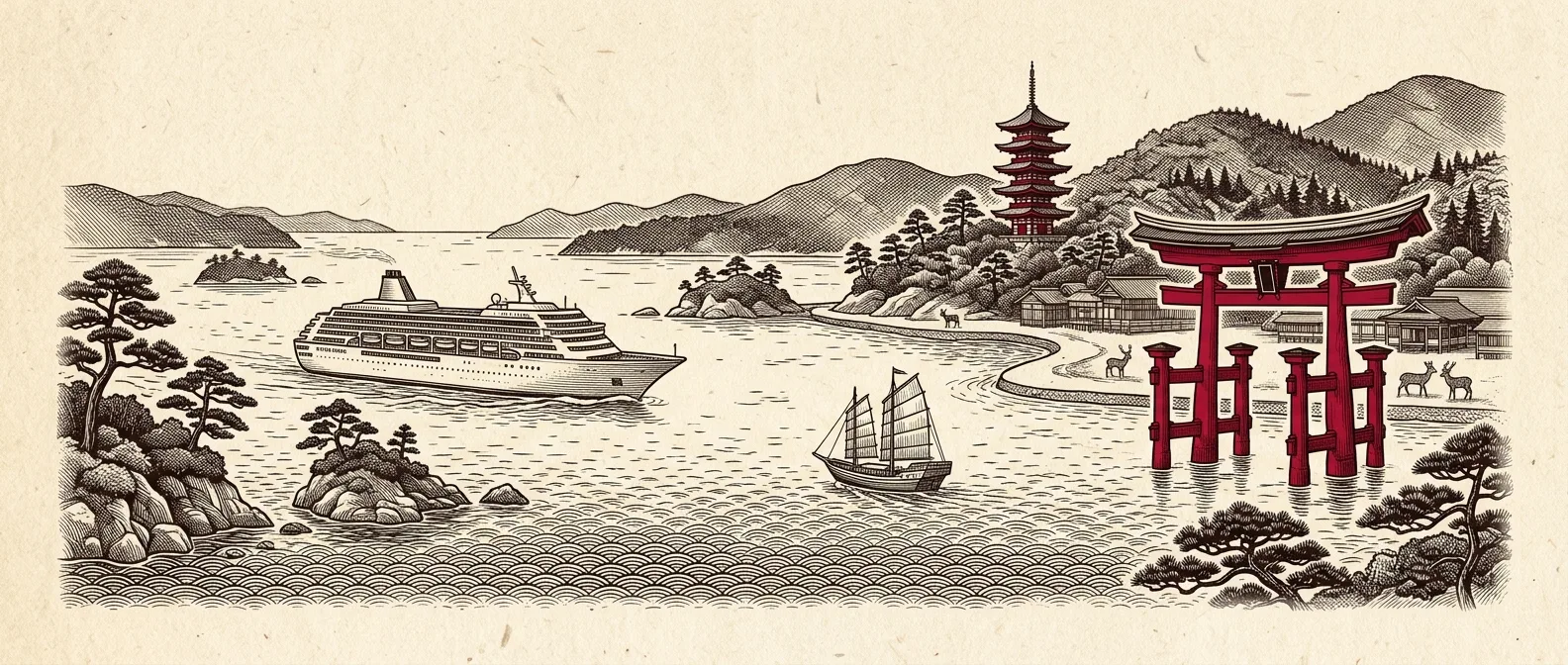
Hiroshima gives you a choice between a quiet museum day and a scenic island day, and the berth is far from both. Ujina is about 20 minutes from downtown by the pier sheet (29 to 50 by streetcar) and about 60 from Itsukushima Shrine. See the Hiroshima guide.
Nagasaki
One of the best independent ports. The tram runs a flat 150 yen, the sights cluster near the terminal, and the Atomic Bomb Museum and Peace Park deserve real time. Hashima is a long add-on whose landing can be refused. See the Nagasaki guide.
Kagoshima
The volcano is the attraction. A ferry to Sakurajima costs 250 yen and takes about 15 minutes, though the berth is several kilometers from the ferry terminal. See the Kagoshima guide.
Hakodate
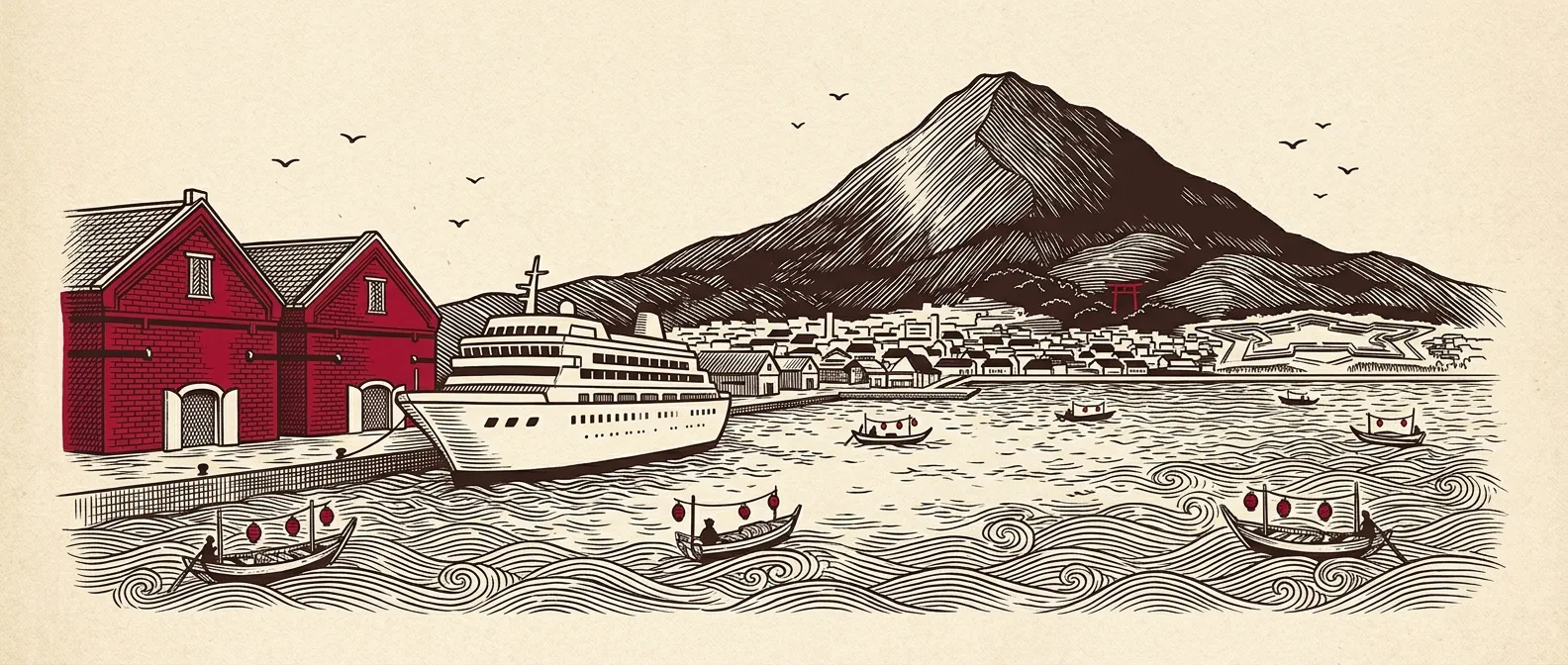
Plan around what is open when you arrive: the Morning Market from 5:00, the Red Brick Warehouses from 9:30, and the ropeway, which is closed from 20 October to 8 November 2026. See the Hakodate guide.
Otaru
The easiest port to explore on foot once you arrive. About 15 minutes from the pier to the station, with the canal, glass and sushi street close by. See the Otaru guide.
Kanazawa
A 30-minute bus from the port gets you to Kenrokuen and the teahouse district. Hours have shortened since 16 October. See the Kanazawa guide.
The Seto Inland Sea and Smaller Ports
The Chugoku region, which includes Hiroshima, Kure, Onomichi and Fukuyama, logged 383 calls in 2025. Onomichi's Bella Vista Marina had 95 calls, all by Japan-operated ships, and the anchorage off Miyajima had 49, 32 of them Japan-operated. The Hiroshima guide has the detail.
Ship Size Decides Which Berth You Get
Japan's ports vary a lot in what they can take, and that is why two ships on the "same" itinerary can have very different days. A few published examples:
- Hiroshima (Ujina) has a 390-meter berth with no air-draft limit, and recent callers include MSC Bellissima at about 172,000 gross tons and Quantum of the Seas at about 168,000. There is no boarding bridge, so passengers use the ship's own gangway (MLIT).
- Kagoshima (Chuo district) has a 410-meter quay for ships up to about 220,000 gross tons.
- Kobe has two mobile boarding bridges at Shinko Pier No. 4, and some large ships may not reach certain berths because of a bridge limit, according to cruise forum reports.
- Tokyo's Harumi terminal takes only small and mid-size ships that fit under Rainbow Bridge, while the Tokyo International Cruise Terminal takes the largest.
- Otaru has reported size limits that conflict between sources, from about 50,000-ton class at Pier 3 to 130,000 to 140,000-ton class at Katsunai Wharf.
- Kure has a 260-meter, 7.5-meter-deep berth that suits small ships such as Pacific Venus at about 26,600 gross tons.
The practical rule is to ask which berth your ship will use before you read a port guide, because the minutes in that guide are measured from a specific place.
How These Ports Fit Common Itineraries
Most Japan cruises follow one of a few patterns, and the ports above slot into them in predictable ways. The Japan cruise planning guide describes the round-trip "Circle Japan" route, which departs from and returns to Yokohama, Kobe or Osaka over 7 to 14 days. A shorter loop sticks to Honshu's big ports, such as Yokohama for Tokyo and Osaka or Kobe for Kyoto and Nara. Longer ones add Kagoshima in the south, and 12 to 14 day versions add Hokkaido ports like Hakodate or Otaru, and sometimes Kanazawa or Nagasaki.
- A Honshu loop. Yokohama, Kobe or Osaka, and perhaps Hiroshima. Mostly easy, with one or two big day trips.
- A Kyushu-leaning route. Nagasaki and Kagoshima, often with Hiroshima. A good mix of independent days and one scenic stop.
- A Hokkaido addition. Hakodate and Otaru, both small and walkable, though Hakodate's market timing needs thought. CruiseMapper's Hakodate listing, a secondary source, gives a season of about April to October, so Hokkaido ports suit a spring-to-autumn sailing.
- A Sea of Japan stop. Kanazawa, where the bus ride is the main cost.
Which season you go in changes the hours as well as the weather, and the best time to cruise Japan lays out the trade-offs.
Opening Hours Change With the Month
The same call can give you more or less time at a sight depending on when you sail. This cheat sheet collects the published closing times that shift most.
| Sight | Longer hours | Shorter hours |
|---|---|---|
| Kenrokuen, Kanazawa | 7:00 to 18:00, 1 March to 15 October | 8:00 to 17:00, 16 October to end of February |
| Itsukushima Shrine, Miyajima | 6:30 to 18:00, 1 March to 14 October | 6:30 to 17:30, 15 October to 30 November, then 6:30 to 17:00 in December |
| Meiji Jingu, Tokyo | sunrise to sunset: 5:40 to 16:40 in October | 6:40 to 16:00 in December |
| Sanjusangendo, Kyoto | 8:30 to 17:00 from 1 April | 9:00 to 16:00, 16 November to 31 March |
| Kotoku-in (Great Buddha), Kamakura | 8:00 to 17:30, April to September | 8:00 to 17:00, October to March |
| Mount Hakodate ropeway | last up 21:30, 20 April to 30 September | last up 20:30, 1 October to 19 April (closed 20 October to 8 November 2026) |
Sources are the sights' own pages, linked in the Kanazawa, Hiroshima, Tokyo, Osaka and Hakodate guides. The pattern is the same everywhere: the shoulder season and winter cost you an hour or more at the end of the day. Treat the last entry, often 30 minutes before closing, as the real deadline.
How to Choose
Pick ports by what you want a day to feel like.
- You want food above all. Osaka, Kobe, Hakodate, Otaru and Kanazawa are the strongest. Osaka for street food, Kobe for beef, Hakodate and Otaru for seafood, Kanazawa for its market.
- You want history. Hiroshima and Nagasaki, handled slowly. Kyoto and Nara, handled selectively.
- You want landscape. Kagoshima's volcano and Miyajima's torii.
- You want an easy day. Otaru, Nagasaki, Kobe and Osaka, where the sights come to you.
- You want a city. Yokohama with a Tokyo half-day.
For timing and season, the best time to cruise Japan covers cherry blossom, autumn and summer, and the first-time tips cover the logistics.
Planning a Port Day
Two decisions shape every port day, and each has its own guide.
First, how much time you really get. Subtract the round trip to your first stop and a 30-minute buffer from the time between arrival and all-aboard. On an 8-hour window, one-way trips of 15 minutes and 60 minutes leave about 7 hours and 5.5 hours. The time budget guide walks through it with a worked example.
Second, whether to book the ship's excursion. The ship waits for tours it sells, and doesn't for independent plans. Princess lists Kyoto excursions from $124.95 to $244.95, and the JR leg from Kobe is roughly 2,200 yen round trip by journey-planner fares, so going alone can cost a fraction of that. The excursions guide compares them port by port.
What I Checked and What I Couldn't
The statistics are MLIT's final 2025 figures. The distances and times come from port authority sheets, city pages and operators, and rail and metro fares come from journey planners, so treat fares as close, not exact. I could not verify typical call lengths, which cruise line uses which Yokohama pier, or many individual opening hours from official pages. Those gaps are flagged in each guide. Prices shift every year, so reconfirm anything that matters, and check your ship's daily schedule, which is the only authority on all-aboard time.
For booking-level questions, the Japan cruise planning guide, the cost breakdown, the cruise line comparison and the visa and entry guide cover the rest.
Frequently Asked Questions
Which Japan cruise port is the best?
There is no single best. For ease, Otaru, Nagasaki, Kobe and Osaka. For scenery, Kagoshima and Miyajima. For a big city, Yokohama with a half-day in Tokyo.
How many cruise ships visit Japan?
MLIT counted 3,116 cruise calls in 2025, 2,353 by foreign-operated ships and 763 by Japan-operated ships, at ports across the country.
Which Japanese port has the most cruise calls?
Yokohama, with 209 in 2025, followed by Hakata with 208 and Naha with 205. Nagasaki has the most foreign-operated calls at 194.
Do I need to book shore excursions in Japan?
Not for most ports, where trains and trams are easy. They make most sense for far-away sights like Itsukushima Shrine or for scarce bookings like Hashima.
The Bottom Line
Treat each port as its own small trip with its own arithmetic. Check the berth distance, the opening hours for your month, and the ship's all-aboard time, and then choose a plan that fits the window you actually have. Start with the guide to the port on your itinerary, and use the time budget and excursion guides to turn it into a plan.