Japan Cruise Port Days: Realistic Time Budgets for Every Port Type
How much time you really get ashore on a Japan cruise port day, with a simple formula, three port types, and the published travel times from each berth.
The most common planning mistake on a Japan cruise is treating the port day as a full day. It is a window. It opens when you clear the gangway and closes well before the ship sails, and the commute eats both ends of it. A plan that looks fine on a map can leave you with three hours at the sight you came for.
Subtract the round trip to your first stop and a 30-minute buffer from the time between arrival and all-aboard, and what is left is your real port day. On an 8-hour window, a berth that is a 15-minute walk from the station leaves about 7 hours. A berth that is 60 minutes from the sight leaves about 5 and a half.
Everything below uses travel times published by port authorities and city tourism offices, collected in the other guides in this cluster (the Kobe figure is from a secondary source, and the Ujina figure is from a different pier sheet than the Itsukushima one). The window itself, the 08:00 arrival and 16:00 all-aboard, is an assumption for the worked example, because I could not find an official standard call length for Japan's ports. Your ship's daily schedule is the only number that counts.
Key Takeaways
- The formula is: window ashore minus two times the travel time minus a 30-minute buffer. Plan the buffer around the ship's all-aboard time, not its sailing time.
- Published one-way times from the berth range from about 5 minutes (Osaka's walk to Osakako Station, and Kobe's Port Liner from a secondary source) to about 60 minutes (Hiroshima's Ujina berth to Itsukushima Shrine).
- On a worked example of an 8-hour window, the same day leaves between 5.5 and 7 hours at the sights depending on the berth and the first stop you pick (the chart's first stops differ: a station, central Tokyo and a shrine).
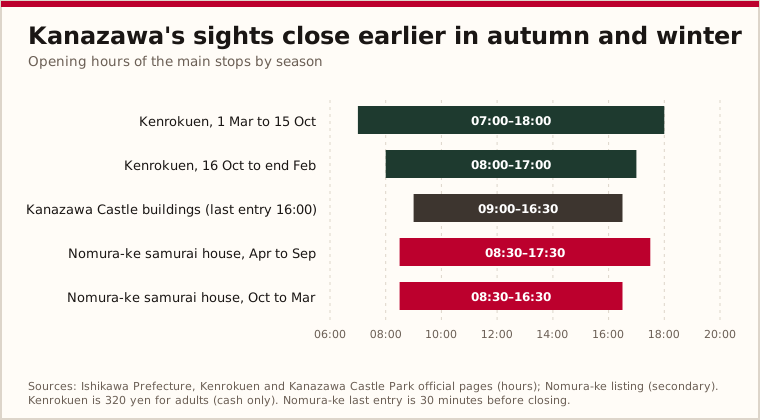
- Sights close early in autumn and winter. Kenrokuen closes at 17:00 from 16 October, and last entry at the sights I checked is typically 10 to 30 minutes before closing.
- NCL asks guests to be back on board at least one hour before sailing, and other lines set their own rule, so read the all-aboard time on your own schedule.
The Formula
Port days follow arithmetic, and arithmetic is easier to trust than a feeling.
Usable time = (all-aboard time − arrival time) − (2 × one-way travel to your first stop) − buffer.
Three terms matter. The window is set by your ship. The travel is set by the berth. The buffer is yours to choose. I use 30 minutes, which covers a late train, a queue at the gangway, and the walk from the station to the ship gate. It comes on top of the travel time back, so at a 60-minute port you leave the sight 90 minutes before all-aboard.
The formula leaves out two things: your immigration clearance at the first Japanese port, and any wait at a ticket office. I could not find an official figure for clearance time, so it is not in the formula. Ask your line how it handles arrival clearance.
What the Worked Example Shows
Take an 8-hour window: arrive 08:00, everyone aboard by 16:00. That matches a sailing at 17:00 under an NCL-style rule of one hour before departure, but it is an illustration, not data.
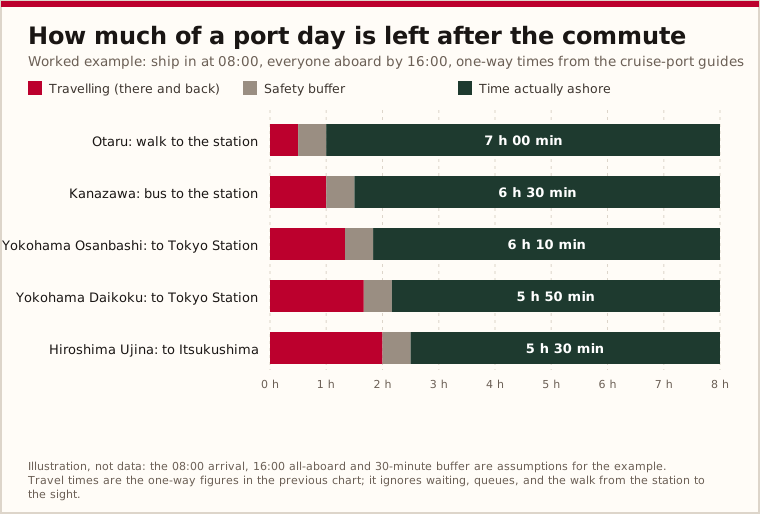
The spread between the best and worst case is only about an hour and a half of usable time, but the experience differs more than that. A 15-minute walk is an easy morning. A 60-minute trip each way is a commitment that fails if one connection slips. The chart also ignores the walk from the station to the sight itself, which is why a "7 hour" day rarely means 7 hours at the temple.
Three Port Types
Most Japan cruise ports fall into one of three types, and the type tells you how to plan before you look at a timetable.
Walk-off ports
You can reach the town on foot. Otaru's Pier 3 is about a 15-minute walk from JR Otaru Station, down Chuo-dori (Otaru City). Osaka's Tempozan wharf is about a 5-minute walk to Osakako Station (City of Osaka). Yokohama's Osanbashi is about 5 to 7 minutes from Nihon-odori Station (City of Yokohama).
Budget: most of the window for sights near the berth. Plan two or three things and take a long lunch, but check exactly where the ship is.
Short-ride ports
A short train, tram or bus gets you into the city. Kobe's Port Liner reaches Sannomiya in about 5 minutes (a secondary source, so confirm the fare). Nagasaki's Matsugae terminal has a tram stop within a short walk (MLIT). Hiroshima's Ujina berth is about 7 km and 20 minutes from downtown, and the pier sheet says shuttles to downtown are required. Ujina fits both this type and the next: 20 minutes to downtown, 60 to Itsukushima (MLIT).
Budget: a half day of city sightseeing plus a long lunch. The risk is not the first ride but the return.
Long-haul ports
The sight you came for is an hour or more away. Kyoto from the Osaka and Kobe berths (Princess says about an hour from Kobe by train alone), Tokyo from Yokohama's Osanbashi at about 40 minutes (City of Yokohama) and from Daikoku at about 50 by train plus taxi (same page), and Itsukushima Shrine from Ujina at about 60 (MLIT). See the Tokyo and Hiroshima guides.
Budget: one destination only. A ship excursion often makes sense here because of the late-return guarantee. See ship excursions vs. exploring independently.
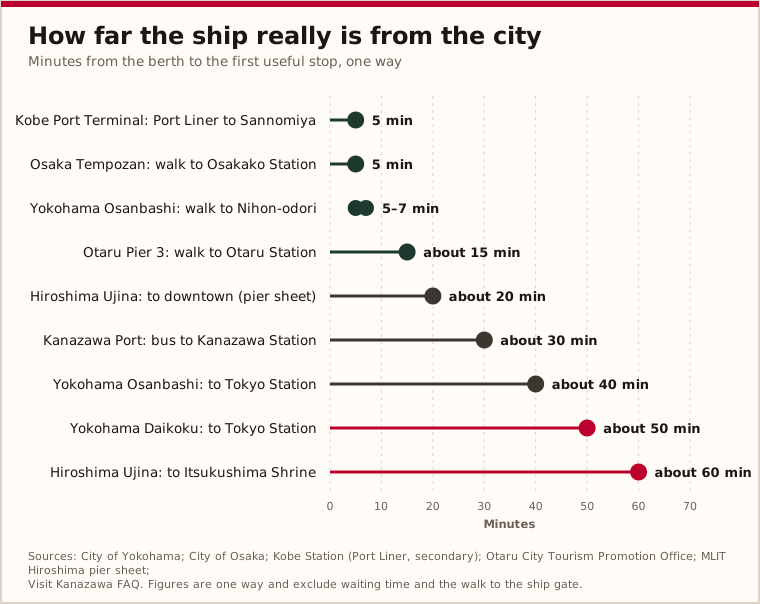
These are one-way figures from city, port and tourism-office sources, and they exclude waiting time and the walk to the ship gate. Daikoku Pier is the outlier in Yokohama: the city lists no public transit or shuttle there, only about 15 minutes by taxi to the nearest station.
Opening Hours Cut Your Window Too
The window is not only the ship's. Sights have their own hours, and they shrink in the cooler months.
Kenrokuen in Kanazawa is open 7:00 to 18:00 from 1 March to 15 October, then 8:00 to 17:00 until the end of February (Ishikawa Prefecture). Itsukushima Shrine closes at 18:00 until 14 October, at 17:30 from 15 October to 30 November, and at 17:00 in December (Itsukushima Shrine). Meiji Jingu in Tokyo closes at sunset, as early as 16:00 in December (Meiji Jingu).
So a late-autumn call that looks identical on the schedule can leave you less time inside than a spring one. Check the closing time for the month you sail, and treat the last entry as the real deadline: many sights stop admitting 10 to 30 minutes before they close.
Museums are the other common trap. Many close on Mondays, and some set their own closed day, so check the day of the week of your call. I haven't listed individual museums here because I could not verify their hours against official pages, which is itself a reason to check each one yourself.
The Cost of a Missed Connection
Japan's trains are punctual, but plan as if one will slip anyway. JR Central reports an average delay of 1.6 minutes per Shinkansen train for fiscal 2023, including delays from natural disasters (JR Central). Small numbers add up when the connection is the last one that gets you aboard.
Typhoons are the larger risk. I did not find an official peak-season statement, though travel guides generally put it in August and September, and in September 2026 Cruise Hive reported a ship forced to stay put in Tokyo as Typhoon Dujuan approached (Cruise Hive). That is a trade press report, not an official rate, and I found no published national figure for how many calls typhoons cancel. The sensible reading is that a late-summer Japan sailing can change its schedule at short notice, so keep your plans loose and your excursions refundable where you can.
A Simple Planning Routine
A routine beats improvisation on port days. This is the one I would use.
- Read the schedule the night before. Write the all-aboard time on your hand or phone, not the sailing time.
- Subtract your one-way travel time back to the ship, plus 30 minutes. That is the clock time you must be leaving the sight.
- Compute usable time with the formula. If it is under 4 hours, choose one thing.
- Check the sight's closing day and last entry. Sort by closing time, not by fame.
- Fix lunch first. A fixed meal makes the rest of the day easier to plan.
- Set a turnaround time. Pick a clock time, say 14:30, when you start heading back no matter what.
- Have a backup. If the first plan fails, know the second sight that is near the berth.
For a first Japan cruise in general, the first-time cruise tips pair well with this routine.
Frequently Asked Questions
How long are Japan cruise port calls?
There is no single standard I could verify, and times vary by sailing and by line. Use your own daily schedule.
Is 8 hours enough to see Kyoto from the Osaka or Kobe berth?
It is enough for one or two sights if the round trip stays under about two hours. Princess describes its Kyoto excursions as running 8 to 10 hours including travel, which tells you how much of a port day Kyoto takes (Princess Cruises). The Osaka and Kobe guide breaks down the trip.
What buffer should I leave before all-aboard?
I use a 30-minute buffer on top of the travel time back. NCL asks guests to be back on board at least an hour before the scheduled departure and says the ship's clock governs (NCL), so your deadline is earlier than the sailing time.
Does the formula work for ports not covered here?
Yes. Replace the one-way travel time with the time from your berth to the first useful stop, as given by the port authority or the cruise line's port page.
The Bottom Line
A port day is a window you can calculate. Take the time between arrival and all-aboard, subtract two commutes and a buffer, and plan to that number, not to the number on the itinerary. Start with the Japan cruise ports guide to find your berth, then decide whether to book a ship tour or go alone with the excursions guide.