Yokohama & Tokyo Cruise Port Guide: A DIY Day in Port
How to spend a day in port when your Japan cruise calls at Yokohama or Tokyo: which pier you dock at, sourced transit times and fares, and three DIY plans.
Many Japan cruises sold as "Tokyo" actually dock in Yokohama. About seven in ten Tokyo-area calls in 2025 were at Yokohama, 209 against 82 at Tokyo according to MLIT. Yokohama is about 30 kilometers down the coast, and the rest of the day depends on which pier your ship uses. One pier puts a train station a few minutes' walk away. Another has no public transit at all.
If your ship docks at Yokohama's Osanbashi pier, go independent: the nearest station is a 5 to 7 minute walk and Tokyo Station is about 40 minutes away. If it docks at Daikoku Pier, plan for a taxi or a ship shuttle, because the city lists no public transit there. Either way, pick one of three plans: stay in Yokohama, take a half day in Tokyo, or go to Kamakura.
I haven't sailed into Yokohama myself, so this guide gives you the published numbers instead of a story. Every time, fare and opening hour comes with its source and was checked on 21 October 2026. Rail fares come from journey planners and move a little, so treat them as close, not exact.
Key Takeaways
- Yokohama was Japan's busiest cruise port in 2025 with 209 calls, up from 146 in 2024, and Tokyo had 82 calls (MLIT).
- Osanbashi pier is a 5 to 7 minute walk from Nihon-odori Station and about 40 minutes from Tokyo Station by bus or train. Daikoku Pier lists no public transit and is about 15 minutes by taxi from the nearest station.
- From Nihon-odori, Shibuya is 37 to 39 minutes by through train (about 533 yen). Asakusa takes 57 to 62 minutes with two transfers (about 972 yen).
- Kamakura is about 24 minutes from Yokohama on the JR Yokosuka Line (about 440 yen), and the Great Buddha at Kotoku-in is a 7 minute walk from Hase Station.
- The ship's pier is not published by line, so confirm it in your cruise documents before planning anything.
Which Pier Will Your Ship Use?
Three terminals handle most cruise traffic around Tokyo Bay, and they could hardly be more different.
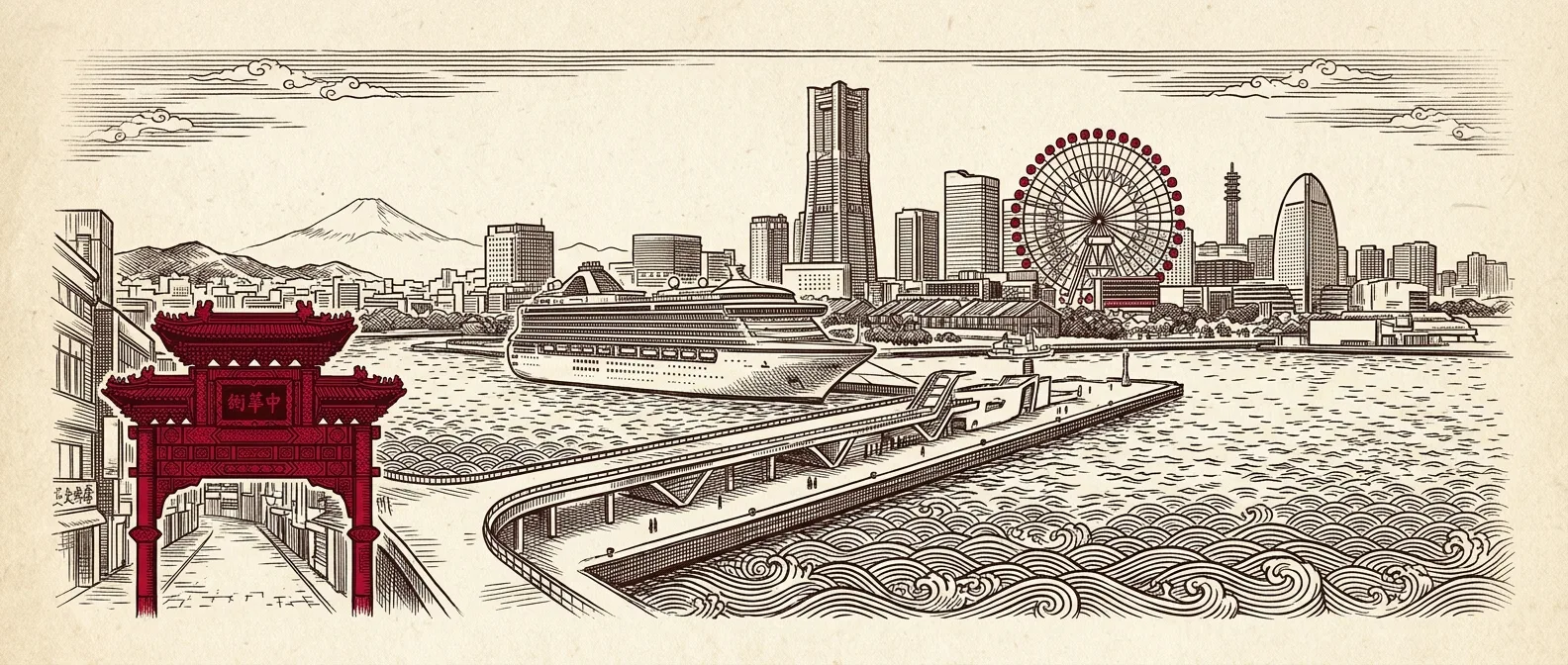
Yokohama Osanbashi has four mobile boarding bridges and a customs, immigration and quarantine plaza of about 2,000 square meters. The nearest station is Nihon-odori on the Minatomirai Line, a walk of about 5 minutes on one city page and 7 on another, so call it 5 to 7. Kannai Station is about a 15-minute walk, and city bus line 26 runs from Sakuragicho and Yokohama Station to a stop at the pier's entrance (City of Yokohama).
Daikoku Pier has no boarding bridges. The terminal is a building of about 5,000 square meters beside cargo warehouses. The city names Motomachi-Chukagai and Shin-Koyasu as the nearest stations, each about 15 minutes by taxi, and lists no public bus or shuttle (City of Yokohama). A cruise line may run its own shuttle on a given sailing, so ask.
Tokyo's own terminals are separate. The Tokyo International Cruise Terminal in Aomi opened in 2020, takes the largest ships, and had more than 70 calls in 2025 (Cruise Industry News). Harumi reopened in 2025 after reconstruction but takes only small and mid-size ships that fit under Rainbow Bridge, about 20 to 25 minutes by car from Tokyo Station, per the same Cruise Industry News report.
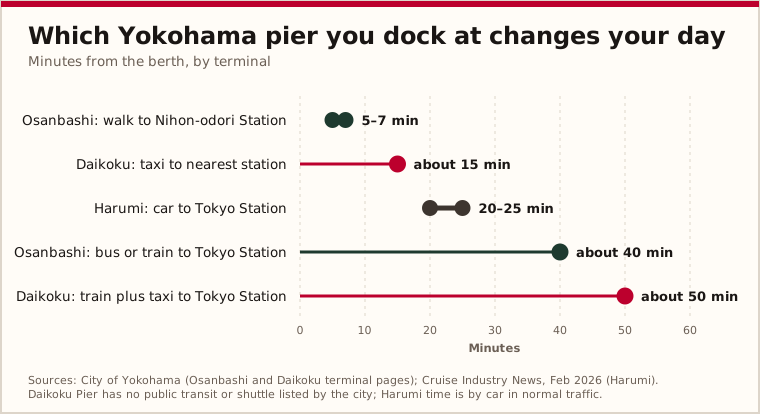
I could not find an official list of which cruise lines use which pier, so I can't tell you where a Princess or Celebrity ship will tie up. Your cruise documents will say. The chart is the reason it matters: the same city is a short stroll or a taxi-dependent trip depending on one line in your itinerary.
Why Yokohama Is So Busy
Yokohama had 209 cruise calls in 2025, the most of any Japanese port, up from 146 and fourth place in 2024. Of those, 105 were foreign-operated ships and 104 were Japan-operated (MLIT). Tokyo had 82 in MLIT's table, with 74 foreign-operated.
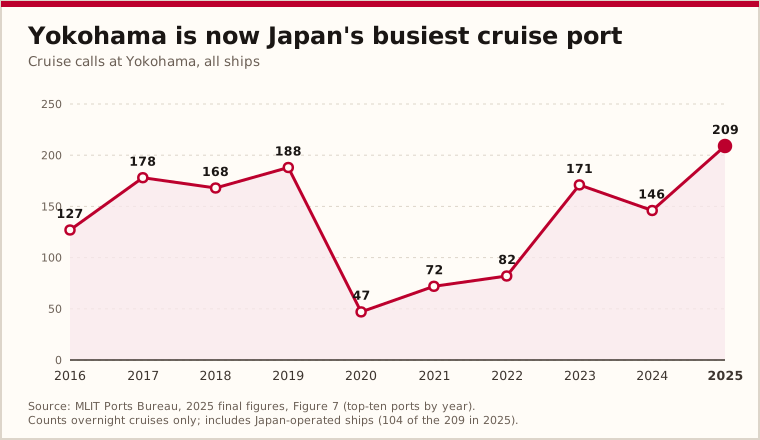
I found no published figure for same-day crowding, but a day with two ships in port is plausible at a busy pier, so leave early.
Getting Around From the Pier
All times below are from journey planners unless noted, so confirm on the day.
| From | To | Time | Fare | Source |
|---|---|---|---|---|
| Osanbashi | Tokyo Station | about 40 minutes by bus or train | n/a | City of Yokohama |
| Nihon-odori Station | Shibuya | 37 to 39 minutes, through train | about 533 yen with an IC card | Navitime (secondary) |
| Nihon-odori Station | Asakusa | 57 to 62 minutes, 2 transfers | about 972 yen with an IC card | Navitime (secondary) |
| Tokyo Station | Yokohama Station | about 28 minutes, JR Tokaido Line | about 483 yen | gltjp.com (secondary) |
| Yokohama Station | Kamakura | about 24 minutes, JR Yokosuka Line | about 440 yen | Navitime (secondary) |
| Kamakura | Hase (Enoden) | 4 to 5 minutes | 200 yen | Enoden |
Daikoku is the odd one out and is not in the table because it has no public transit. The City of Yokohama gives about 50 minutes by train plus taxi from Daikoku to Tokyo Station, versus about 40 from Osanbashi, which understates how much harder it is, because the taxi leg is the part you can't plan around.
Plan A: Stay in Yokohama (Lowest Risk)
If you want to eat well, walk, and be certain of being back, stay put. Yokohama is large enough to fill a day.
Yokohama Chinatown. The city's visitors' guide counts about 600 or more shops, and hours vary by shop (City of Yokohama). A secondary guide (tabi-mag) describes ten gates and a district about 500 meters on a side. There are no fixed hours for the street itself, so go when you want to eat.
Cup Noodles Museum. It is open 10:00 to 18:00 with last admission at 17:00, closed Tuesdays (the next day if Tuesday is a holiday), and costs 500 yen for adults, with high school students and younger free. It is about 8 minutes on foot from Minatomirai Station. The Chicken Ramen Factory needs a reservation (Cup Noodles Museum).
Sankeien Garden. Open 9:00 to 17:00 with last entry at 16:30, 900 yen for adults, closed 26 to 31 December (Sankeien). I could not verify a bus route from the pier, so ask the tourist information desk how to get there.
From Osanbashi, Chinatown and the Cup Noodles Museum are the lower-risk stops because both are on the Minatomirai Line; I did not verify walking times from the pier. Sankeien is further out and I could not verify the route.
Plan B: A Half Day in Tokyo
Tokyo is possible but only as a short, focused trip. Budget about 90 minutes of round-trip travel to Shibuya and over two hours to Asakusa, using the table's times and the walk to the station. By the time budget formula, that leaves roughly 6 hours (Shibuya) or under 5.5 hours (Asakusa) of an 8-hour window before you choose a sight.
Senso-ji. The main hall (Hondo) is open from 06:00 to 17:00, opening at 06:30 from October to March (Senso-ji). The Nakamise shops set their own hours, but most are reported to open around 9:00 to 10:00 and close between 17:00 and 19:00. Asakusa is about 57 to 62 minutes from Nihon-odori with two transfers, so it is a long run for a short visit.
Meiji Jingu. Admission is free and it is open every day, from sunrise to sunset. In October the hours are 5:40 to 16:40, in November 6:10 to 16:10, and in December 6:40 to 16:00 (Meiji Jingu). That sunset closing is the thing to plan around on an autumn or winter call.
Tsukiji Outer Market. The outer market remains open, closed Wednesdays, Sundays and national holidays, best from about 9:00 to 13:00, with many shops cash only (GO TOKYO). Check the day of the week of your call before you set it as your lunch plan.
A rule I would follow: choose one of these, not two. Shibuya is the easiest to reach, with a through train and no transfer, but I would still treat it as a one-sight day.
Plan C: Kamakura (Beach, Temples and the Great Buddha)
Kamakura is the best alternative if you want temples without a Tokyo-sized commute. The JR Yokosuka Line from Yokohama takes about 24 minutes and costs about 440 yen according to Navitime. From Kamakura Station, the Enoden to Hase takes 4 to 5 minutes for 200 yen.
The Great Buddha at Kotoku-in is a 7-minute walk from Hase Station. It is open 8:00 to 17:30 from April to September and 8:00 to 17:00 from October to March, with last entry 15 minutes before closing. Admission is 300 yen for adults, and 50 yen more to go inside the statue, with the interior open 8:00 to 16:30 (Kotoku-in). Add the leg from the pier to Yokohama Station, the wait for each train, and the walk, and allow roughly an hour or more each way. That is my arithmetic from the figures above, not a published time, so check it with a journey planner on the day.
What to Eat
The food stops in this guide are Yokohama Chinatown, the Tsukiji Outer Market and whatever you find in Kamakura. For a primer on what you are looking at, the Japanese food guide and how to eat sashimi help if the market is on your list. The Cup Noodles Museum is about instant noodles, not restaurant ramen, so don't expect a full bowl.
Pitfalls
- Daikoku Pier. A taxi-only start is the main trap. Decide before you land whether you will use the ship's shuttle or a taxi.
- Immigration and baggage queues at Osanbashi. The terminal has a large customs plaza, but I could not verify typical waits, so don't schedule a train to the minute.
- Sunset closures. Meiji Jingu closes as early as 16:00 in December.
- Closed days. The Cup Noodles Museum closes Tuesdays, Tsukiji closes Wednesdays and Sundays.
Ship Excursion or Independent?
Princess lists "Highlights of Tokyo" at 5.25 hours for $129.95 and a Kamakura Great Buddha tour at 4.5 hours for $109.95 (Princess Cruises). From Osanbashi, I would go independent for either plan, since the train access is simple. At Daikoku the excursion looks better because the city lists no public transit there. See ship excursions vs. exploring independently.
Frequently Asked Questions
Does my Tokyo cruise dock in Tokyo or Yokohama?
Most Tokyo-area itineraries use Yokohama, but Tokyo's own terminals take some ships. Your cruise documents list the terminal, and I could not find a published list of which lines use which.
How long does it take to get from the cruise port to Tokyo?
From Osanbashi, about 40 minutes to Tokyo Station by bus or train, per the City of Yokohama. From Daikoku, about 50 minutes by train plus taxi.
Is Kamakura doable on a cruise day?
Yes, if the call is long enough. It is about 24 minutes by JR from Yokohama Station, and the Great Buddha is a short walk from Hase Station. Add the leg from the pier and your waits, which is my own arithmetic.
The Bottom Line
Find out your pier first, then pick one plan. Osanbashi makes all three easy. Daikoku makes everything harder and deserves a shuttle or an excursion. For the next stop on a typical itinerary, read the Osaka and Kobe port guide, and for the whole picture see the Japan cruise ports guide.