Ship Excursions vs. Exploring Independently: How to Decide Per Port
When a Japan cruise excursion is worth it and when to go alone, port by port, using Princess prices, the ship-waits policy and NCL's boarding rule.
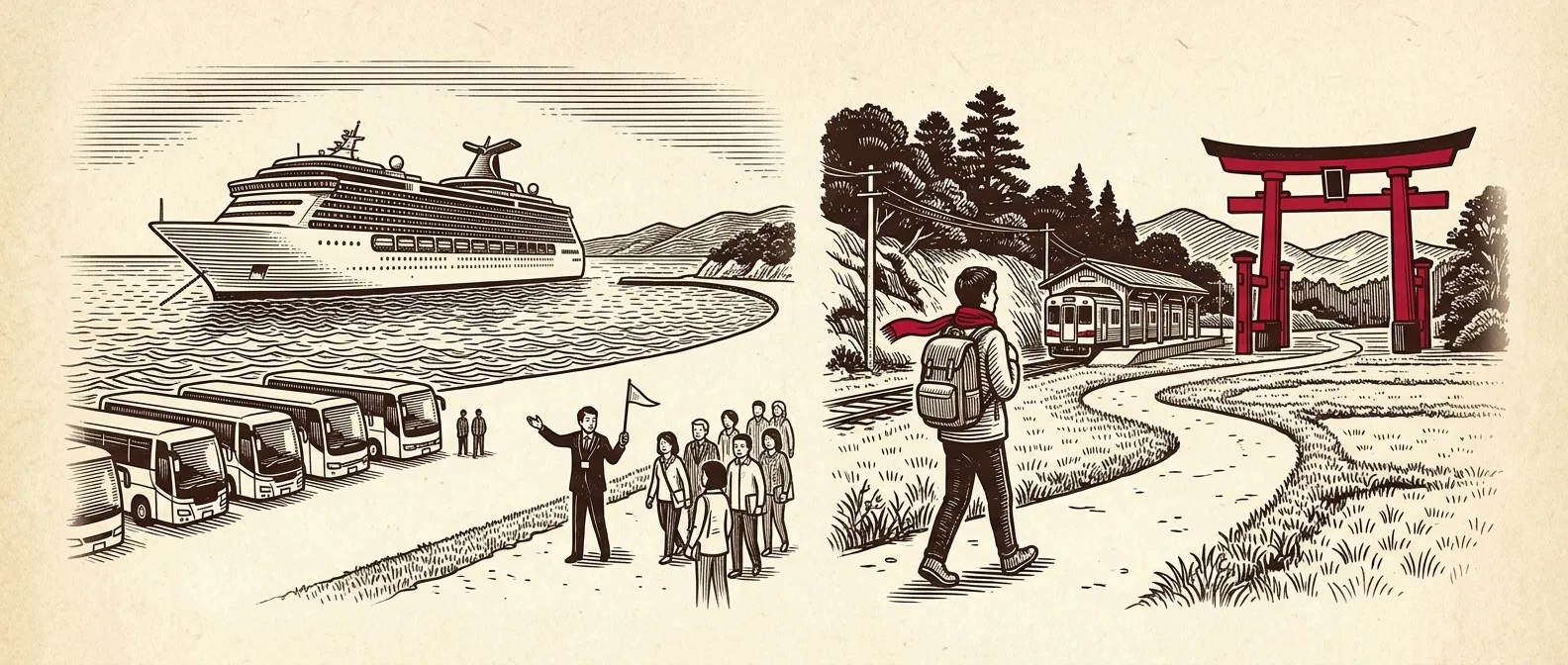
Every Japan cruise port forces the same choice the morning the gangway opens. You can step onto a coach with your ship's name on the windscreen, or you can walk past it and find the train station yourself. Both are reasonable. The right answer changes from port to port, and in my view too much advice treats Japan as if it were one place.
Book the ship excursion when the sight you want is an hour or more from the berth, or when missing the ship would ruin your trip. Go independent when the berth is a short walk or ride from a station and the highlights are close together. In Japan that rule splits the ports cleanly: Otaru, Kobe, Nagasaki, Hakodate (berth-to-town minutes unverified) and the Sakurajima ferry in Kagoshima suit going alone, while Kyoto from Osaka or Kobe, and Miyajima from Hiroshima, are where an excursion earns its price.
Most prices, hours and policies below come from the source named beside them, as published on 21 October 2026, and the table rows link to the port guides that hold the detail. I haven't sailed into these ports myself, so I'm giving you the published numbers rather than a story about how it felt. Check anything that decides your day, such as an all-aboard time, with your own ship.
Key Takeaways
- Princess's Kyoto tours from Osaka and Kobe run $124.95 to $244.95 per person, with its guided options at $189.95 or more and "Kyoto On Your Own" at $124.95. Both ports also list cheaper local tours from about $105 to $110.
- Princess and Celebrity say the ship will wait for tours booked through them. Independent travelers get no such promise, and on NCL you pay your own way to rejoin the ship.
- Port distance decides the question. Otaru Pier 3 is about a 15-minute walk from the station, while Hiroshima's Ujina berth is about 20 minutes from downtown by the pier sheet and about 60 minutes from Itsukushima Shrine.
- A common mistake is a tight independent plan in a port 40 to 60 minutes from the sight. Plan to leave the sight at all-aboard minus your travel time back minus 30 minutes.
- A hybrid works well: take the ship's shuttle or an "on your own" transfer, then walk the rest without a guide.
What the Ship Excursion Actually Buys You
The product is not mainly the guide or the coach. It is the line's stated commitment to wait. Princess says so on its excursion advice page (its Hong Kong site, updated 8 June 2026, so terms may vary by market): if your Princess-booked tour is delayed, the ship will wait for you, and if it cannot wait, Princess arranges your transport to the next port (Princess Cruises). Celebrity's Private Journeys FAQ describes the same arrangement for tours booked through it, with the return arranged at no expense to you if the ship cannot wait (Celebrity Cruises). I did not check other lines' policies, so read yours.
Independent travelers get the opposite. Norwegian's boarding-times page tells guests to be back on board no later than one hour before the ship's scheduled departure, says the ship's clock governs rather than local time, and says a guest who misses the ship pays all expenses to rejoin it (NCL). That is the real cost of going alone: not the train fare, but the small chance of a very expensive afternoon.
Two details are easy to miss. First, all-aboard is not the sailing time. It is usually earlier, and each line sets its own rule, so read the time printed on your own daily schedule. Second, your passport. Celebrity's own FAQ says it is best to carry your passport in case you miss the ship, and notes the ship may collect passports for port clearance, so a photocopy may be useful (Celebrity Cruises). Ask your line what it expects on your sailing.
For how landing permission works, see the Japan cruise visa and entry guide.
How Much More Does the Excursion Cost?
Princess's published "from" prices show the spread clearly. Across the standard sightseeing tours it lists for each port, at Kobe, Osaka, Hiroshima and Hakodate the cheapest and the priciest differ by a factor of two or more, while Tokyo and Yokohama sit in a narrow $110 to $130 band.
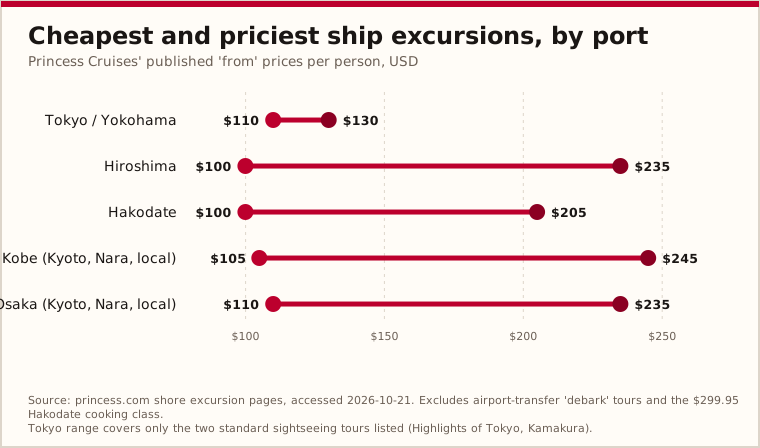
Prices are per person in US dollars, taken from Princess's own pages on 21 October 2026, and they are "from" prices that can change (Kobe, Osaka, Tokyo and Yokohama, Hiroshima, Hakodate). The chart leaves out airport-transfer tours and the $299.95 Hakodate cooking class, which are a different kind of product. Other lines price differently, and I could not verify current excursion prices for Celebrity, Viking, Regent, Holland America or Royal Caribbean, so treat Princess as one reference point, not the market.
The Kyoto numbers
Kyoto is where the choice has the most money attached, because it is the biggest day trip from the Osaka and Kobe berths.
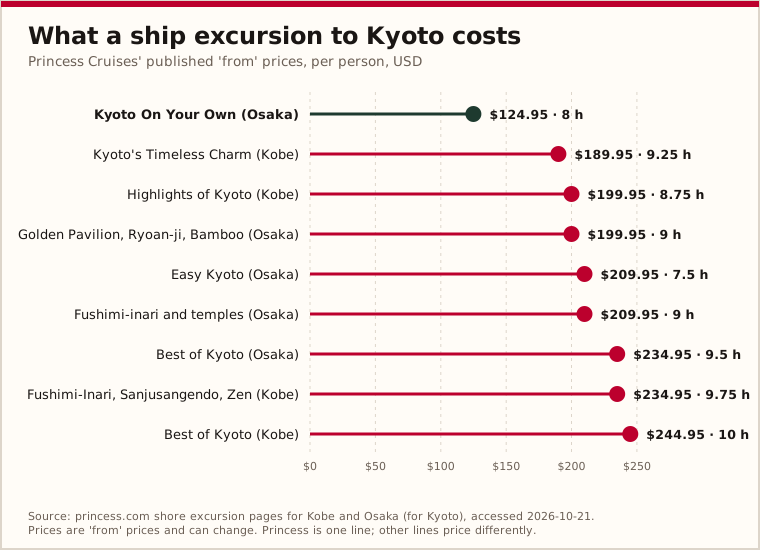
Look at what separates the cheapest bar from the rest. "Kyoto On Your Own" is an 8-hour product at $124.95 that gets you to Kyoto and back without a guided itinerary. The guided Kyoto tours run from $189.95 for 9.25 hours to $244.95 for 10 hours. The gap between the cheapest and priciest is $120 per person, about $240 for two. The guided versions buy a fixed route and a guide. The "on your own" version buys the transport and the convenience of not working out the trains. Neither Princess page says whether the ship-waits commitment applies to "On Your Own", so confirm that with Princess.
Independent travel can undercut both. A journey planner (Navitime) puts the JR Special Rapid from Sannomiya in Kobe to Kyoto at about 1,110 yen and 52 minutes, and Osaka Station to Kyoto at about 580 yen and 29 minutes. Those are secondary figures and fares move, so confirm against JR West before relying on them. The Osaka and Kobe port guide walks through the Kyoto trip in detail.
Port by Port: Which Should You Choose?
Distance from the berth to the first useful stop is the best single predictor. This chart collects the one-way figures from the port guides in this cluster. The Kobe figure is from a secondary source, and the Hiroshima bar measures to Itsukushima Shrine, not to a station.
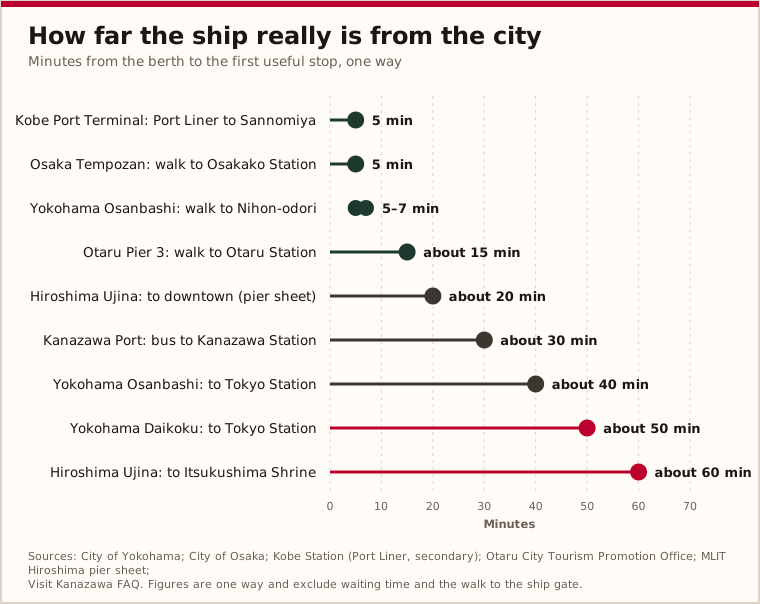
Now the decisions, port by port. "Independent" means the plan works with public transport and the ship's own shuttle.
| Port | Berth to town | My read | Why |
|---|---|---|---|
| Yokohama (Osanbashi) | 5 to 7 minutes' walk to Nihon-odori Station | Independent | Yokohama's sights are close and Tokyo is about 40 minutes by train or bus (City of Yokohama) |
| Yokohama (Daikoku) | No public transit listed, about 15 minutes by taxi to the nearest station | Excursion, or a ship shuttle | The city lists taxi only, so independent plans start with a costly leg |
| Osaka (Tempozan) | About 5 minutes' walk to Osakako Station | Independent for Osaka, either for Kyoto | Metro access is easy and Kyoto is the long day (see the Osaka guide) |
| Kobe | Port Liner to Sannomiya in about 5 minutes | Independent | Short hop to JR, then Osaka, Kyoto or Himeji |
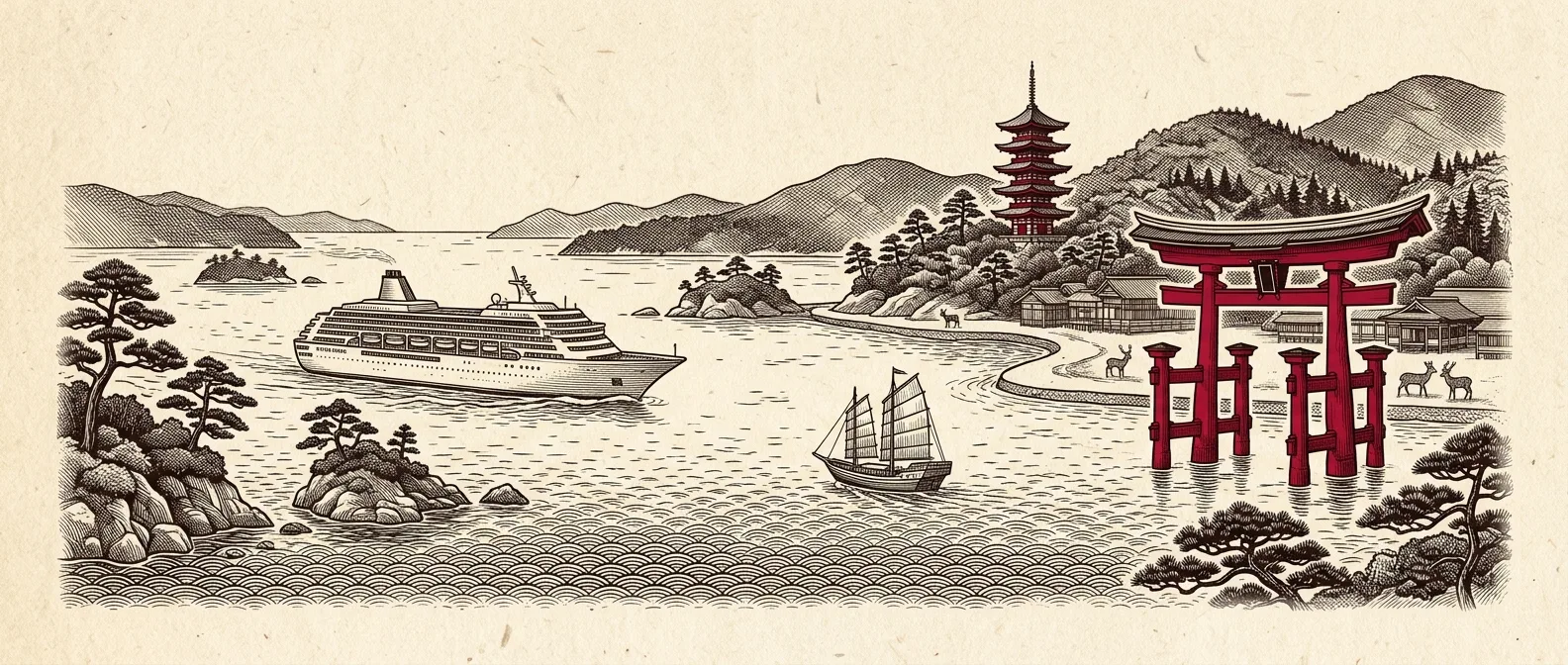
| Hiroshima (Ujina) | About 7 km, 20 minutes to downtown by the pier sheet, shuttle required | Excursion, or shuttle plus tram | The berth is far, and Itsukushima is about 60 minutes away (MLIT pier sheet) |
| Nagasaki (Matsugae) | Tram stop and Glover Garden bus stop within a short walk | Independent | Compact city, tram-based (MLIT) |
| Kagoshima | Chuo district berth, several kilometres from the sights (MLIT puts Sengan-en and Sakurajima roughly 9 to 10 km away) | Shuttle or taxi to town, then independent | The Sakurajima ferry costs 250 yen for adults (Kagoshima City) |
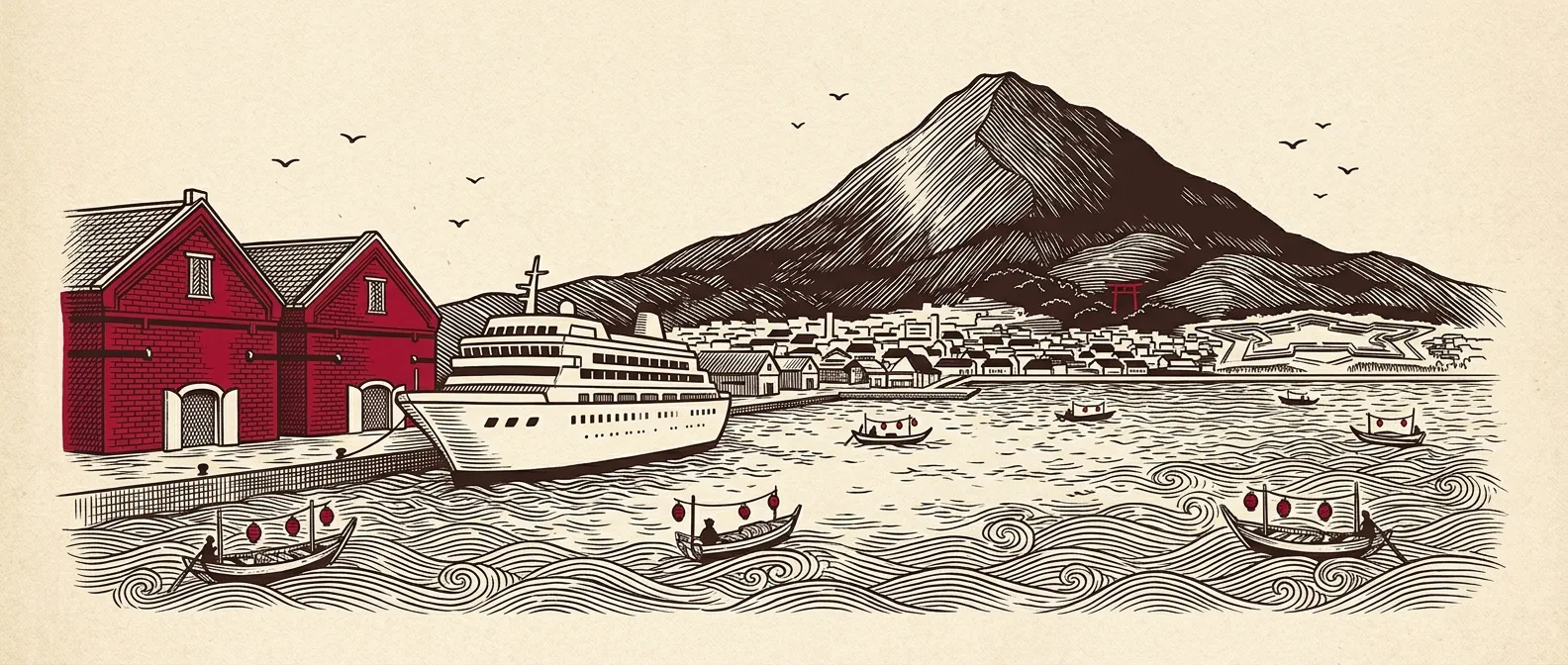
| Hakodate | Shuttle bus to downtown per MLIT | Independent | Per the Hakodate guide, the market, red-brick warehouses and tram are close together, though berth-to-town minutes are unverified |
| Otaru | About 15 minutes' walk to the station | Independent if your ship uses Pier 3 | A 15-minute walk is the longest of the easy independent ports |
| Kanazawa | About 30 minutes by local bus to the station | Either | Kenrokuen is compact, but the berth is far (Visit Kanazawa) |
A few cautions on the table. Which berth your ship uses is set by the line and can change, so check your cruise documents. "Independent" assumes you can read a station sign and carry some cash, because Kenrokuen takes cash only according to the Ishikawa Prefecture page (Ishikawa Prefecture). And a port that suits going alone on a dry autumn day may not on a rainy morning with a tight call.
When a Ship Excursion Is the Smarter Buy
Pay for the tour in these cases:
- The sight is far and your call is short. Hiroshima's Itsukushima Shrine is about 60 minutes from Ujina, and the direct ferry from the Peace Park takes 45 minutes (Aqua Net Hiroshima). A round trip alone eats most of a short call.
- The tour has a booking you cannot get. The Hashima (Gunkanjima) landing tours from Nagasaki run in fixed windows by five operators, need advance booking, and can be refused landing by Nagasaki City rules even in calm weather (Discover Nagasaki). If the ship sells one, you are paying for a pre-arranged seat and the ship-waits commitment, but the landing itself can still be refused.
- You don't want any logistics. Some travelers, reasonably, would rather pay $100 or so than study train timetables on holiday.
- You are traveling with someone who tires easily. A coach door-to-door is a real benefit on a nine-hour day.
When Going Independent Wins
Go alone when these hold:
- The walk or ride to town is under about 20 minutes. Otaru (Pier 3), Osaka and Kobe clear this on the figures I found, and Nagasaki's terminal is described as a short walk from tram and bus stops.
- You want to choose your own lunch. Port-town food is a large part of the point, and tours often fix a meal stop you didn't pick.
- You can pick one thing and do it well. An independent day built around one sight beats a coach day that tries five.
- The cost matters. The cheapest tours still run roughly $100 or more per person at Princess, and two people on a train pay a small fraction of that, even counting the return trip and the leg from the berth.
For port-day planning that works, see the time budget guide, which shows how a long commute reduces the time you actually get ashore.
The Hybrid That Works for Many Ports
You don't have to pick one. Several combinations get most of the value:
- Ship shuttle in, walk from there. Where the line runs a shuttle to the city, use it for the long leg and go independent after.
- "On your own" tour for the long leg. Princess's Kyoto On Your Own is the clearest example: transport handled, itinerary yours.
- One excursion, the rest independent. Book Hashima or Miyajima through the ship, then do the next ports alone. This keeps the line's stated ship-waits commitment for the riskiest day (check your line's terms).
Whichever you pick, set your own deadline well before the ship's. The all-aboard time on your daily schedule is the real constraint, and the figure to plan against is all-aboard minus your travel time back to the ship minus 30 minutes.
Frequently Asked Questions
Will the ship really wait for an excursion that runs late?
For tours booked through the line, Princess and Celebrity both say yes, and describe arranging your onward transport if the ship cannot wait (Princess, Celebrity). That promise does not cover independent travel. Read your own line's current terms, since they can change.
Is an independent day in Japan risky?
JR Central reports an average delay of 1.6 minutes per Shinkansen train for fiscal 2023, including delays from natural disasters (JR Central). That figure covers JR Central's Tokaido Shinkansen only, not the JR West trains on the Kyoto route. In my view the bigger risk is a plan with no buffer, a missed connection, or a sight that closes earlier than you assumed.
Should I book excursions before I sail?
For hard-to-get ones such as Hashima, yes. Operators require advance reservations. For flexible ones, you can usually wait until you know your all-aboard time and the weather.
The Bottom Line
Treat the choice as arithmetic, not as a philosophy. If the first useful stop is within about 20 minutes of the berth, go independent and keep the money. Between 20 and 60 minutes it is a toss-up, so weigh the cost against the ship-waits promise. If it is an hour away, or the booking is scarce, pay for the excursion and the line's stated ship-waits commitment (check your line's terms). Then check the whole route against the Japan cruise ports guide, read the first-time cruise tips, and keep your ship's all-aboard time written on your hand.