Tatakae Meaning: What 戦え Means in Japanese and Attack on Titan
Tatakae (戦え) means "Fight!" in Japanese. Learn the kanji, imperative grammar and pronunciation, tatakae vs tatakau, and why Eren says it.
Tatakae has become a regular internet search. Maybe you heard someone shout it in an anime, or you saw the Eren Yeager meme and wondered what he is actually saying.
Tatakae (戦え) means "Fight!" in Japanese. It is the command form (imperative) of the verb tatakau (戦う), "to fight" or "to battle." It is a blunt, forceful order, and in Attack on Titan it is also a phrase Eren uses to push himself forward.
Key Takeaways
- Meaning: tatakae = "Fight!", "Battle!", "Go fight!"
- Kanji and reading: 戦え, pronounced ta-ta-ka-eh. It is the plain imperative of 戦う (tatakau).
- Grammar: tatakau is a godan (u-verb), so the final う changes to え to make the command.
- Tone: rough and direct. It suits battle cries and self-motivation, not polite conversation.
- Not the same as: tatakai (戦い, "a fight," a noun), tatakau (the dictionary form), or tatake (叩け, "hit it!", from a different verb).
- Fame: it became a well-known anime word through Attack on Titan, where fans often link it to Eren.
What Does Tatakae Mean in Japanese?
Tatakae is the imperative form of tatakau. According to Jisho, which is built on the open JMdict dictionary, tatakau (戦う) covers three related senses (the third is usually written 闘う):
- To make war or fight against an enemy.
- To compete against someone.
- To struggle against or resist hardship and difficulty.
So tatakae can be translated as:
- Fight!
- Battle!
- Go to war!
- Struggle on! / Keep fighting! (when the "enemy" is hardship)
That third sense matters. Japanese uses tatakau for very physical combat, but also for sports matches, illness, and personal struggle. A person can "fight" a disease or "fight" their own fear. That is why tatakae works as a pep talk to yourself, not only as a war cry.
Jisho tags 戦う as a common word, classes it as a godan verb, and marks it as intransitive. It sits at JLPT N3 level, so learners usually meet it after the beginner stage.
How Do You Write Tatakae in Kanji? (戦え vs 闘え)
The kanji in tatakae is 戦 (13 strokes). Jisho's kanji entry lists its meaning as "war, battle, match," and it is a jōyō kanji taught in grade 4, at JLPT N3 level.
It has two main readings:
| Reading type | Reading | Example |
|---|---|---|
| On'yomi (Chinese-derived) | セン (sen) | 戦争 (sensō, war) |
| Kun'yomi (native Japanese) | たたか.う (tataka.u), いくさ (ikusa) | 戦う (tatakau, to fight) |
You may also see tatakau written with 闘う. Jisho lists 闘う as an alternate written form of the same verb, and notes the form 斗う as rare. Jisho marks the first two senses (war, competing) as "esp. 戦う" and the third (struggling against adversity) as "esp. 闘う," so 戦 leans toward war and contests while 闘 leans toward struggle. In everyday writing 戦う is the standard form, and tatakae written as 闘え is a legitimate variant.
How to Pronounce Tatakae
If you are new to reading Japanese script, our guide to how Japanese is read explains how kanji and kana work together.
Say it as four even syllables: ta-ta-ka-e.
- The "e" is like the "e" in "bet," not an English "ay." So it is not "tatakay."
- Every syllable gets roughly the same length. Do not stress one syllable heavily the way English does.
- In romaji you will see tatakae written all in lowercase, and in Japanese text it is 戦え or たたかえ.
Why Is Tatakae a Command? (Japanese Imperative Grammar)
Japanese has several ways to give orders, and tatakae uses the plainest one, the imperative (命令形, meireikei). The grammar site Bunpro lays out the rule like this:
- Godan (u-verbs): change the final kana to the え row. 戦う (tatakau) becomes 戦え (tatakae).
- Ichidan (ru-verbs): replace る with ろ (colloquial) or よ (formal or written). 見る (miru) becomes 見ろ (miro) or 見よ (miyo).
- Irregular verbs: する becomes しろ, and 来る becomes 来い.
Tatakau ends in う, which is the godan pattern, so the only option is tatakae. There is no "-ro" version, which is one reason it sounds so clean and punchy.
Is Tatakae Rude?
It can be. Bunpro calls the imperative the most direct and abrasive way to give an order, says it is rarely used in daily conversation, and notes it mainly turns up on signs and posters, or shouted at sports events, demonstrations and in urgent situations. Its warning for learners is to avoid it because it "might sound rude and threatening."
That does not mean it is always insulting. Context decides. A coach shouting at a team, a hero talking to himself, or a character in a war story all use it naturally. What you would not do is order your coworker or a stranger to do something with it.
Related Forms of Tatakau
Here is the whole family of forms for tatakau, so you can see where tatakae fits:
| Form | Japanese | Romaji | Meaning |
|---|---|---|---|
| Dictionary form | 戦う | tatakau | to fight |
| Polite form | 戦います | tatakaimasu | I fight / will fight |
| Imperative | 戦え | tatakae | Fight! |
| Prohibitive | 戦うな | tatakau na | Don't fight! |
| Polite request | 戦ってください | tatakatte kudasai | Please fight |
| Volitional | 戦おう | tatakaō | Let's fight |
| Te-form | 戦って | tatakatte | fighting / and fight |
| Negative | 戦わない | tatakawanai | doesn't fight |
| Past | 戦った | tatakatta | fought |
| Potential | 戦える | tatakaeru | can fight |
| Instruction-style command | 戦いなさい | tatakainasai | Fight (softer than 戦え, the kind of order a parent or teacher gives) |
| Noun | 戦い | tatakai | a battle, a fight |
Two small traps are worth spotting:
- Tatakae vs. tatakaeru. The imperative 戦え and the potential 戦える look very close. The potential means "can fight," not "fight!"
- Tatakae vs. tatakai. Tatakai is the noun that comes from the stem of the verb. "Tatakai ga hajimaru" would be "the battle begins," while tatakae is the order itself.
Tatakae vs. Tatakau vs. Tatake
People often mix these up, so here is a quick comparison:
| Word | Japanese | What it is | Meaning |
|---|---|---|---|
| Tatakau | 戦う | Dictionary form of a godan verb | to fight |
| Tatakae | 戦え | Imperative of 戦う | Fight! |
| Tatake | 叩け | Imperative of 叩く (tataku) | Hit! Strike! |
Tatake (叩け) comes from tataku, a different verb meaning "to hit" or "to strike" (as when you tap a drum). It sounds nearly the same as tatakae, which is why listeners sometimes mishear one for the other, but the sense is very different.
The big takeaway is that the final sounds tell you the verb type. A command ending in -e usually points to a godan verb. A command ending in -ro or -yo points to an ichidan verb, such as 見ろ (miro).
Tatakae in Attack on Titan
Tatakae became famous worldwide through Attack on Titan (Shingeki no Kyojin), the manga by Hajime Isayama. Kodansha USA lists the English edition as a complete series in 35 volumes, and it was adapted into an anime.
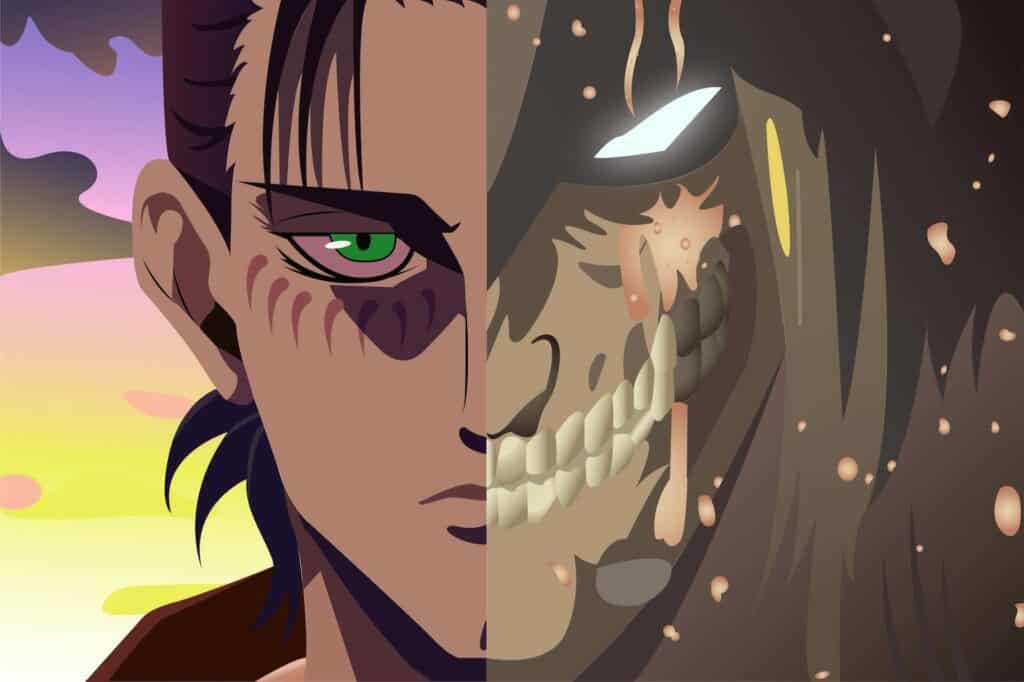
The story follows Eren Yeager and his fight against the man-eating giants known as Titans, who threaten humanity. Fans often connect the word tatakae with Eren and his determination.
Why Is Tatakae Linked to Eren?
Fans often link the word to Eren, who is driven by a refusal to stop. It also works as more than an order to somebody else: a command form can be self-talk, a reminder to keep moving when things get hard. It is short, strong, and has no politeness getting in the way.
A line from the series that teaches useful grammar is "tatakawanakereba katenai" (戦わなければ勝てない), usually translated as "if you don't fight, you can't win." Japanese quote-collection sites attribute it to young Eren speaking to Mikasa in episode 6 of the first season, though these are secondary fan sources, so check the episode itself if you need a precise quote. As grammar, the -nakereba form means "if you don't...", and katenai is the negative of 勝てる (kateru), the potential form of 勝つ (katsu, "to win"). So the sentence says you cannot win unless you fight.
If you are curious about Eren's choices more broadly, our post on why Eren attacked Mikasa goes deeper into his character. And if you want to watch the series in English, check whether Attack on Titan is dubbed on Crunchyroll.
Tatakae, Tatakaō, Tatakau and Tatakawanakereba Compared
These four forms of the same verb get mixed up often. Readings and meanings below follow the standard conjugation rules for godan verbs ending in う, as covered by Bunpro and Jisho.
| Form | Japanese | Reading | Feels like | Example |
|---|---|---|---|---|
| Imperative | 戦え | tatakae | A direct order | 敵と戦え! (teki to tatakae) "Fight the enemy!" |
| Volitional | 戦おう | tatakaō | "Let's fight" / "I will fight" | 最後まで戦おう (saigo made tatakaō) "Let's fight to the end" |
| Dictionary | 戦う | tatakau | A plain statement | 彼は病気と戦う (kare wa byōki to tatakau) "He fights his illness" |
| Conditional negative | 戦わなければ | tatakawanakereba | "If you don't fight..." | 戦わなければならない (tatakawanakereba naranai) "I must fight" |
Notice how the same verb changes role. 戦え pushes someone else, 戦おう invites a group to act together, 戦う just reports, and 戦わなければならない expresses obligation. In the last pattern, the -nakereba form means "if you do not...", and adding ならない makes it "must."
Common Conjugations of 戦う
| Pattern | Japanese | Reading | Meaning |
|---|---|---|---|
| Polite negative | 戦いません | tatakaimasen | doesn't fight |
| Negative past | 戦わなかった | tatakawanakatta | didn't fight |
| Passive | 戦われる | tatakawareru | is fought |
| Causative | 戦わせる | tatakawaseru | makes someone fight |
| Progressive | 戦っている | tatakatte iru | is fighting |
| Want to | 戦いたい | tatakaitai | wants to fight |
A practical tip: when you want to rally a group without sounding bossy, the volitional 戦おう is usually friendlier than the imperative 戦え, because it includes the speaker in the action. The te-form 戦って (tatakatte) also lets you chain actions, as in 戦って勝つ (tatakatte katsu), "fight and win," which is a handy pattern for building longer sentences.
Tatakae vs. Ganbare: Two Kinds of "Fight!"
English uses "fight!" for both a war cry and a cheer. Japanese splits those jobs.
| Word | Japanese | Feels like | When to use it |
|---|---|---|---|
| Tatakae | 戦え | A combat order or battle cry | Literal fights, war stories, fierce self-talk |
| Ganbare | 頑張れ | Encouragement | Cheering on a friend, a team, an exam taker |
Ganbare (頑張れ) is the imperative of ganbaru (頑張る), which Jisho defines as "to persevere, persist, or do one's best." If a friend is about to take an exam, ganbare is the natural choice. Tatakae there would sound strangely aggressive, as if you were sending them into combat.
Should You Ever Say Tatakae Yourself?
As a learner, you can say it safely in a few situations: when you are joking with friends about an anime, when you are quoting a character, or when you are talking to yourself during something hard, like a tough workout or a long study session.
Avoid it with teachers, coworkers, or anyone you do not know well. If you want to encourage somebody, choose ganbare, or a softer phrase like ganbatte kudasai ("please do your best"). Tone matters more than the dictionary meaning here, and a bare command from a stranger can feel like an attack.
If you want to practice, try making commands from other u-verbs using the same rule. For example, 行く (iku, to go) becomes 行け (ike), and 書く (kaku, to write) becomes 書け (kake). Spotting the pattern is a quick way to turn a famous anime line into real grammar knowledge.
What Anime Does and Does Not Teach You
The word "fight" does a lot of work in Japanese. As the Jisho senses above show, tatakau also covers competing against a rival and struggling against hardship, which is why one verb can feel like a war cry in one scene and a personal pep talk in another. Anime and manga carry these words to a global audience, and they are an easy way into the language and into what makes Japanese culture unique.

Anime has limits as a teacher, though. Characters use rough imperatives constantly, while in real conversation you will almost always use a polite request (~てください), a softer suggestion, or no command at all. Learn the grammar from a proper course or reference, then use anime to reinforce it. If you want to read the source material, start with our manga for beginners list, or see how manga differs from light novels.
Frequently Asked Questions
What does tatakae mean in English?
Tatakae means "Fight!" or "Battle!" It is the imperative form of the verb tatakau (戦う), "to fight," and it works as both a command to others and a way to motivate yourself.
How do you write tatakae in Japanese?
It is written 戦え in kanji, or たたかえ in hiragana. Some people also write it 闘え, a variant of the same verb.
Is tatakae the same as tatakau?
No. Tatakau (戦う) is the dictionary form meaning "to fight." Tatakae (戦え) is the command form meaning "Fight!" The difference is that tatakae gives an order, while tatakau just names the action.
What is the difference between tatakae and tatakai?
Tatakai (戦い) is a noun meaning "a battle" or "a fight." Tatakae is the command "Fight!" One names the conflict, the other tells someone to enter it.
Is tatakae polite?
No. It is the plain imperative, which sounds blunt and rough. For a polite version, use 戦ってください (tatakatte kudasai), "please fight," although in practice you would rarely need that exact phrase.
How is tatakae different from ganbare?
Tatakae is a combat-flavored order to fight. Ganbare (頑張れ) is encouragement meaning "do your best." Use ganbare to cheer someone on and tatakae for literal or dramatic fighting.
Is tatakae the same as tatake?
No. Tatake (叩け) is the command form of tataku (叩く), "to hit." It sounds similar, but it comes from a different verb and means something different.
Wrap-Up
Tatakae is a one-word grammar lesson. Learn that it comes from a godan verb, and you can also read 行け, 書け and dozens of other commands, plus decide for yourself when a bare order is the wrong tool. If you want to see more of the series behind the word, our Attack on Titan dubbing guide is a good next stop.