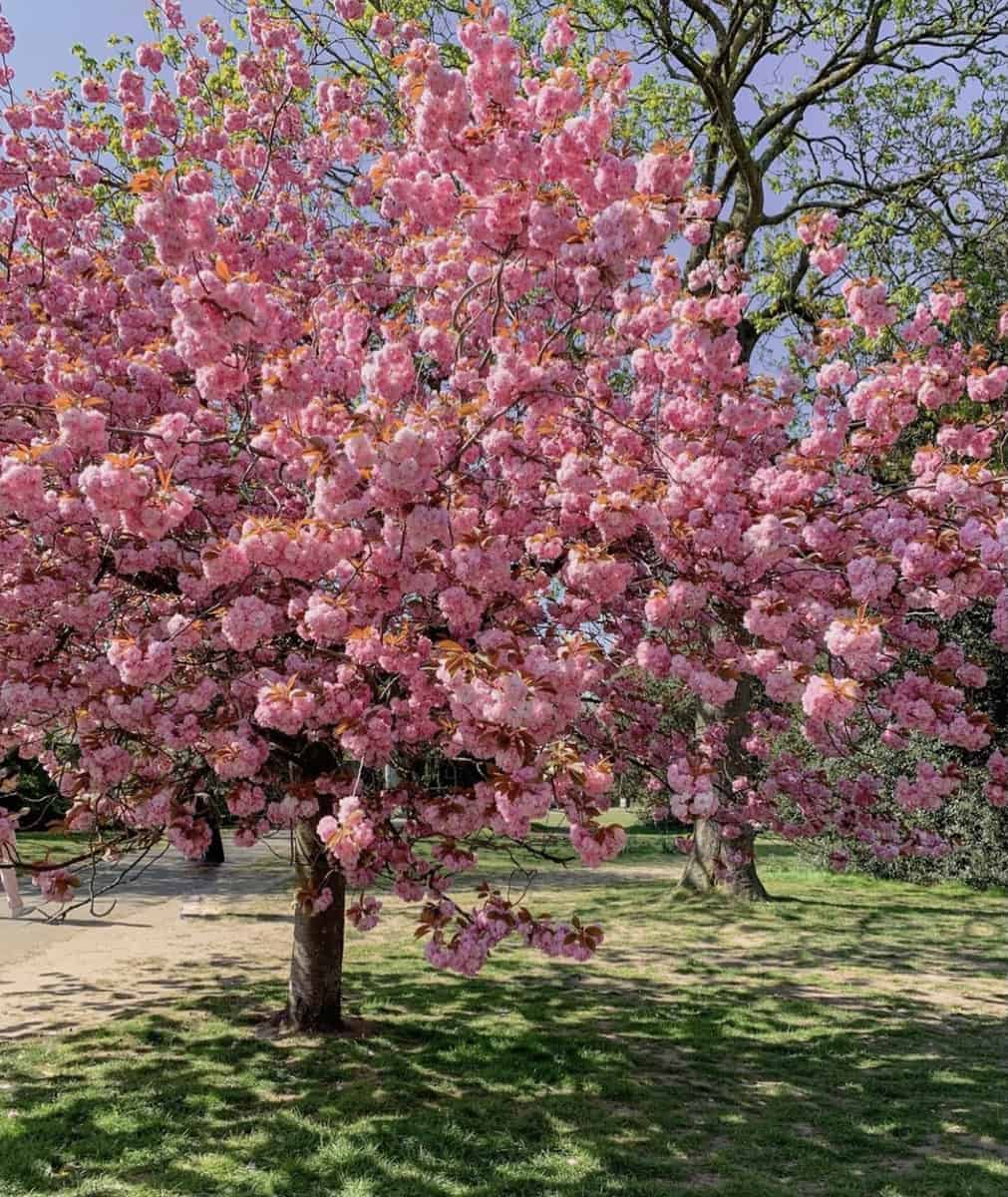
Where Can Cherry Blossoms Grow in the US? A Zone-by-Zone Guide for Every State
Cherry blossoms can grow in most of the US, roughly USDA zones 4 to 9. Use the zone matcher and state table to see which flowering cherry fits where you live.
By Yuuna·Updated
Flowering cherry trees can grow across most of the United States, in USDA hardiness zones 4 to 9 depending on the variety. That covers the Northeast, the Mid-Atlantic, the upper South, the Midwest and Great Lakes, much of the Pacific Northwest and parts of California. They struggle where winters are too cold (north of zone 4), where summers are hot and humid and winters are too mild (the Gulf coast and southern Florida), and in the desert Southwest extremes. This guide shows you which cherry fits which zone, with a matcher, a state-by-state table and four charts.
Key Takeaways
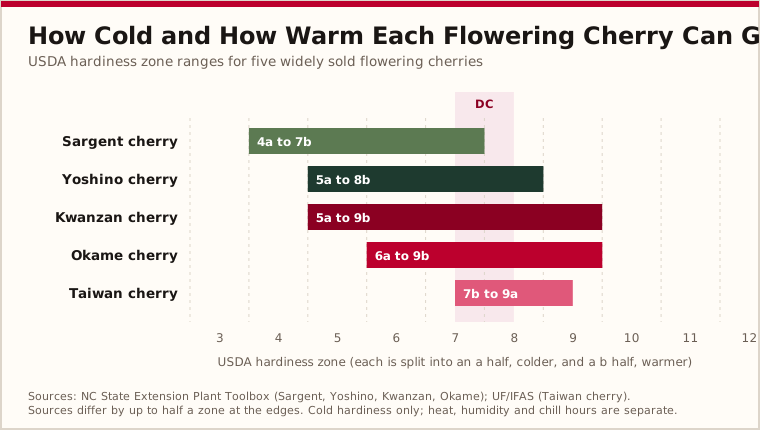
- Zone range: five widely sold flowering cherries together cover zones 4a to 9b: Sargent (4a to 7b), Yoshino (5a to 8b), Kwanzan (5a to 9b), Okame (6a to 9b) and Taiwan cherry (7b to 9a).
- Most of the US fits on zones alone: in my state table, 30 of 51 places (50 states plus DC) have every hardiness zone inside a cherry's range, and 17 more have most of theirs.
- Zones are only half the answer. They describe winter cold, not summer heat, humidity, soil or how much winter chill a tree gets.
- For hot places, pick low-chill, heat-tolerant types such as Okame and Taiwan cherry. Sargent is the one to avoid south of zone 7.
- Bloom time runs from January to April, earliest in Florida and latest in the Northeast.
- Check your exact zone by ZIP code at planthardiness.ars.usda.gov, then use the matcher below.

Which Cherry Blossom Tree Goes in Which Zone?
If you only read one section, read this table. Find your USDA zone, and the trees in the right-hand column are listed for it. "Edge" means you are at the cold or warm limit of the tree's listed range, where it is likelier to struggle.
| Your zone | Cherries listed for it | Notes |
|---|---|---|
| 3 and colder | None of the five | Ask your county Extension office about hardy flowering trees |
| 4 | Sargent | Sargent is the hardiest of the group |
| 5 | Sargent, Yoshino, Kwanzan | The classic zone for Yoshino and Kwanzan |
| 6 | Sargent, Yoshino, Kwanzan, Okame | The widest choice |
| 7a | Sargent, Yoshino, Kwanzan, Okame | Sargent is listed to 7b, but NC State warns heat and humidity can be a problem south of zone 7 |
| 7b | Sargent (at its warm limit), Yoshino, Kwanzan, Okame, Taiwan cherry (at its cold limit) | Washington, DC is about 7b to 8a |
| 8 | Yoshino, Kwanzan, Okame, Taiwan cherry | Yoshino reaches its warm limit at 8b |
| 9 | Kwanzan, Okame, Taiwan cherry (9a only) | Heat and low chill become the issue |
| 10 and warmer | None of the five | Ask your county Extension office about flowering trees for warm climates |
The Five Flowering Cherries Compared
I used the five cherries below because they have published zone ranges from university extension services. There are many more cultivars, but these show how the choice changes from north to south.
| Cherry | USDA zones | Height | Bloom | Heat note | Good to know |
|---|---|---|---|---|---|
| Sargent (Prunus sargentii) | 4a to 7b | 20 to 30 ft | Spring; single pink flowers | Poor: high heat and humidity can be a problem south of zone 7 | Foliage can scorch in hot summers |
| Yoshino (Prunus x yedoensis) | 5a to 8b | 30 to 40 ft | Spring; white flowers last 2 to 3 weeks | Tolerates heat and humidity | The most commonly planted cherry around Washington, DC |
| Kwanzan (Prunus serrulata 'Kanzan') | 5a to 9b | 25 to 36 ft | Spring; deep pink double flowers | Not rated in the source I reviewed | Susceptible to borers, scale and some fungal and viral diseases |
| Okame (Prunus 'Okame') | 6a to 9b | 15 to 30 ft | Late winter to early spring; flowers last about 3 weeks | Heat tolerant; prefers shade from hot afternoon sun | Low chill requirement, but early flowers can be hit by a late freeze |
| Taiwan cherry (Prunus campanulata) | 7b to 9a | Up to about 20 ft | January or February | The most heat-tolerant flowering cherry (UF/IFAS) | Short-lived, about 10 to 15 years |
Sources differ by half a zone at the edges. NC State lists Okame for zones 6a to 9b while UF/IFAS lists 6b to 9b, and one UF/IFAS fact sheet gives Taiwan cherry as 7a to 9a rather than 7b to 9a. When in doubt, take the more conservative number.
Cherry Blossom Zone Matcher
Pick your state to narrow the zone list, choose your exact zone, and pick what matters most to you. The tool ranks the five cherries for your zone.
- Yoshino cherryGood fitzones 5a to 8b. 30 to 40 ft. Spring; white flowers last about 2 to 3 weeks.
- Kwanzan cherryGood fitzones 5a to 9b. 25 to 36 ft. Spring; deep pink double flowers.
- Okame cherryGood fitzones 6a to 9b. 15 to 30 ft. Late winter to early spring; flowers about 3 weeks.
- Sargent cherryEdge of rangezones 4a to 7b. 20 to 30 ft. Spring.At the edge of its listed zones; expect a harder time.
- Taiwan cherryEdge of rangezones 7b to 9a. Up to 20 ft. January or February.At the edge of its listed zones; expect a harder time.
How Much of Each State Falls in Cherry Blossom Range?
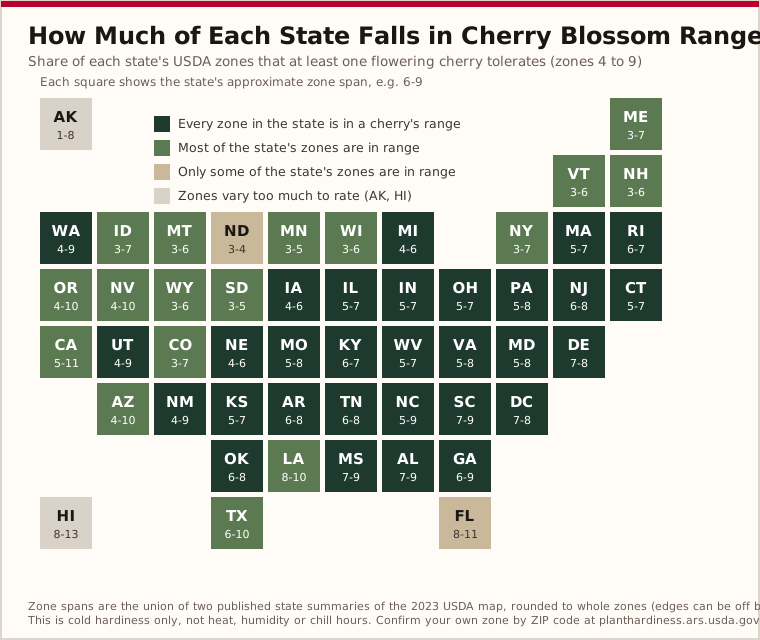
The map below colours every state by how many of its hardiness zones sit inside the combined zone range of the five cherries (4a to 9b). Dark green means every zone in the state is covered. Lighter green means most are.
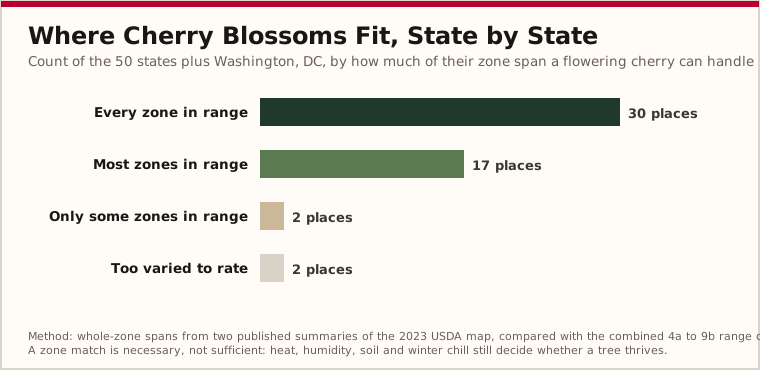
A few things stand out:
- Most of the country is covered. Thirty of the 51 places have every zone inside the range, including the whole Mid-Atlantic and most of the Midwest and upper South.
- The cold north and the hot south are the gaps. North Dakota (zones 3 to 4) overlaps only at its warmest edge. Florida (8 to 11) overlaps in its northern half.
- Large, varied states fall in the middle. Texas, California, Oregon, Arizona and Nevada span so many zones that "most" is the honest label. Where you live inside the state decides the answer.
- Alaska and Hawaii are too varied to rate from a zone range alone. Use your ZIP-code zone.
Cherry Blossoms by State: Search and Filter
Use the table to look up your state, or filter by region and by how much of the state the cherries cover. It lists which of the five trees fit the whole state and which fit only part of it.
| State | Zones | Fit | Cherries listed for the whole state / part of it |
|---|---|---|---|
| Alabama | 7 to 9 | Every zone in range | Whole state: Kwanzan, Okame Part of state: Sargent, Yoshino, Taiwan |
| Alaska | 1 to 8 | Varies too much to rate | Part of state: Sargent, Yoshino, Kwanzan, Okame, Taiwan |
| Arizona | 4 to 10 | Most zones in range | Part of state: Sargent, Yoshino, Kwanzan, Okame, Taiwan |
| Arkansas | 6 to 8 | Every zone in range | Whole state: Yoshino, Kwanzan, Okame Part of state: Sargent, Taiwan |
| California | 5 to 11 | Most zones in range | Part of state: Sargent, Yoshino, Kwanzan, Okame, Taiwan |
| Colorado | 3 to 7 | Most zones in range | Part of state: Sargent, Yoshino, Kwanzan, Okame, Taiwan |
| Connecticut | 5 to 7 | Every zone in range | Whole state: Sargent, Yoshino, Kwanzan Part of state: Okame, Taiwan |
| Delaware | 7 to 8 | Every zone in range | Whole state: Yoshino, Kwanzan, Okame Part of state: Sargent, Taiwan |
| FloridaState guide | 8 to 11 | Only some zones in range | Part of state: Yoshino, Kwanzan, Okame, Taiwan |
| Georgia | 6 to 9 | Every zone in range | Whole state: Kwanzan, Okame Part of state: Sargent, Yoshino, Taiwan |
| Hawaii | 8 to 13 | Varies too much to rate | Part of state: Yoshino, Kwanzan, Okame, Taiwan |
| Idaho | 3 to 7 | Most zones in range | Part of state: Sargent, Yoshino, Kwanzan, Okame, Taiwan |
| Illinois | 5 to 7 | Every zone in range | Whole state: Sargent, Yoshino, Kwanzan Part of state: Okame, Taiwan |
| Indiana | 5 to 7 | Every zone in range | Whole state: Sargent, Yoshino, Kwanzan Part of state: Okame, Taiwan |
| Iowa | 4 to 6 | Every zone in range | Whole state: Sargent Part of state: Yoshino, Kwanzan, Okame |
| Kansas | 5 to 7 | Every zone in range | Whole state: Sargent, Yoshino, Kwanzan Part of state: Okame, Taiwan |
| Kentucky | 6 to 7 | Every zone in range | Whole state: Sargent, Yoshino, Kwanzan, Okame Part of state: Taiwan |
| Louisiana | 8 to 10 | Most zones in range | Part of state: Yoshino, Kwanzan, Okame, Taiwan |
| Maine | 3 to 7 | Most zones in range | Part of state: Sargent, Yoshino, Kwanzan, Okame, Taiwan |
| Maryland | 5 to 8 | Every zone in range | Whole state: Yoshino, Kwanzan Part of state: Sargent, Okame, Taiwan |
| Massachusetts | 5 to 7 | Every zone in range | Whole state: Sargent, Yoshino, Kwanzan Part of state: Okame, Taiwan |
| Michigan | 4 to 6 | Every zone in range | Whole state: Sargent Part of state: Yoshino, Kwanzan, Okame |
| Minnesota | 3 to 5 | Most zones in range | Part of state: Sargent, Yoshino, Kwanzan |
| Mississippi | 7 to 9 | Every zone in range | Whole state: Kwanzan, Okame Part of state: Sargent, Yoshino, Taiwan |
| Missouri | 5 to 8 | Every zone in range | Whole state: Yoshino, Kwanzan Part of state: Sargent, Okame, Taiwan |
| Montana | 3 to 6 | Most zones in range | Part of state: Sargent, Yoshino, Kwanzan, Okame |
| Nebraska | 4 to 6 | Every zone in range | Whole state: Sargent Part of state: Yoshino, Kwanzan, Okame |
| Nevada | 4 to 10 | Most zones in range | Part of state: Sargent, Yoshino, Kwanzan, Okame, Taiwan |
| New Hampshire | 3 to 6 | Most zones in range | Part of state: Sargent, Yoshino, Kwanzan, Okame |
| New Jersey | 6 to 8 | Every zone in range | Whole state: Yoshino, Kwanzan, Okame Part of state: Sargent, Taiwan |
| New Mexico | 4 to 9 | Every zone in range | Part of state: Sargent, Yoshino, Kwanzan, Okame, Taiwan |
| New York | 3 to 7 | Most zones in range | Part of state: Sargent, Yoshino, Kwanzan, Okame, Taiwan |
| North Carolina | 5 to 9 | Every zone in range | Whole state: Kwanzan Part of state: Sargent, Yoshino, Okame, Taiwan |
| North Dakota | 3 to 4 | Only some zones in range | Part of state: Sargent |
| Ohio | 5 to 7 | Every zone in range | Whole state: Sargent, Yoshino, Kwanzan Part of state: Okame, Taiwan |
| Oklahoma | 6 to 8 | Every zone in range | Whole state: Yoshino, Kwanzan, Okame Part of state: Sargent, Taiwan |
| Oregon | 4 to 10 | Most zones in range | Part of state: Sargent, Yoshino, Kwanzan, Okame, Taiwan |
| Pennsylvania | 5 to 8 | Every zone in range | Whole state: Yoshino, Kwanzan Part of state: Sargent, Okame, Taiwan |
| Rhode Island | 6 to 7 | Every zone in range | Whole state: Sargent, Yoshino, Kwanzan, Okame Part of state: Taiwan |
| South Carolina | 7 to 9 | Every zone in range | Whole state: Kwanzan, Okame Part of state: Sargent, Yoshino, Taiwan |
| South Dakota | 3 to 5 | Most zones in range | Part of state: Sargent, Yoshino, Kwanzan |
| Tennessee | 6 to 8 | Every zone in range | Whole state: Yoshino, Kwanzan, Okame Part of state: Sargent, Taiwan |
| Texas | 6 to 10 | Most zones in range | Part of state: Sargent, Yoshino, Kwanzan, Okame, Taiwan |
| Utah | 4 to 9 | Every zone in range | Part of state: Sargent, Yoshino, Kwanzan, Okame, Taiwan |
| Vermont | 3 to 6 | Most zones in range | Part of state: Sargent, Yoshino, Kwanzan, Okame |
| Virginia | 5 to 8 | Every zone in range | Whole state: Yoshino, Kwanzan Part of state: Sargent, Okame, Taiwan |
| Washington | 4 to 9 | Every zone in range | Part of state: Sargent, Yoshino, Kwanzan, Okame, Taiwan |
| Washington, DC | 7 to 8 | Every zone in range | Whole state: Yoshino, Kwanzan, Okame Part of state: Sargent, Taiwan |
| West Virginia | 5 to 7 | Every zone in range | Whole state: Sargent, Yoshino, Kwanzan Part of state: Okame, Taiwan |
| Wisconsin | 3 to 6 | Most zones in range | Part of state: Sargent, Yoshino, Kwanzan, Okame |
| Wyoming | 3 to 6 | Most zones in range | Part of state: Sargent, Yoshino, Kwanzan, Okame |
Cherry Blossoms by Region
Northeast and New England
Zone-wise, this is prime territory. Rhode Island, Connecticut, Massachusetts, New Jersey and Pennsylvania are covered by Sargent, Yoshino and Kwanzan, and Yoshino-type cherries are the classic choice. Newark, New Jersey's Branch Brook Park is the Northeast's best-known display; the Branch Brook Park Alliance reports more than 5,300 cherry trees in 18 varieties, and its festival is held each April. Further north (Maine, New Hampshire, Vermont, upstate New York), spans reach down to zone 3, so choose Sargent or look for a protected site.
Mid-Atlantic and the Upper South
Washington, DC sits at about zone 7b to 8a, and the National Park Service describes its Tidal Basin cherries as mostly Yoshino. Sources count roughly 3,700 trees around the Tidal Basin and National Mall. NPS defines peak bloom as the point when 70 percent of the blossoms are open, and the average peak falls around April 3 to 4, with a record range from March 15 (1990) to April 18 (1958). Virginia, Maryland, Delaware, Kentucky, Tennessee and North Carolina fit Yoshino, Kwanzan and Okame by zone.
The Deep South
Georgia, Alabama, Mississippi and South Carolina span zones 6 to 9, so Yoshino, Kwanzan, Okame and Taiwan cherry all appear in range. Macon, Georgia, holds a festival around its Yoshino cherries; the organisers say more than 350,000 trees bloom there each March. I found no audited count, so treat that as the festival's own figure. Heat, humidity and mild winters are the challenges as you go south, and low-chill types such as Okame are the usual answer.
Florida and the Gulf Coast
Florida's zones run from about 8 to 11, so only the northern half is zone-compatible, and the Gulf coast of Louisiana runs warm too. Taiwan cherry and Okame are the best-supported choices, and they flower in winter, not spring. My full guide is Can You Grow Cherry Blossom Trees in Florida?. This picker shows which cherry fits each part of the state:
- Okame cherryGood fitzones 6b to 9b. Needs few chill hours; reported flowering in January and February well into Central Florida (UF/IFAS).
- Taiwan cherryEdge of rangezones 7b to 9a. Well suited to North Florida gardens (UF/IFAS Extension).
- 'Akebono' Yoshino cherryOutside rangezones 5b to 8a.
Texas, the Southwest and the Mountain West
Texas spans roughly zones 6 to 10. Okame and Kwanzan are listed up to zone 9b, so zone 10 along the southern coast is outside their range. Arizona, Nevada, New Mexico and Utah span a huge range, from zone 4 mountains to zone 10 deserts. Zone data cannot tell you how a tree handles intense sun, dry air or alkaline soil, and I could not find an authoritative Texas-specific chill-hour table for these cherries. For those states, treat the matcher as a first filter and ask your county Extension office. NC State advises protecting Okame from hot afternoon sun and reflected heat, which matters in the Southwest.
Midwest and Great Plains
Illinois, Indiana, Ohio, Missouri, Kansas and Kentucky fall in zones 5 to 8 and are covered by Sargent, Yoshino and Kwanzan. Minnesota, the Dakotas, Wisconsin and Michigan reach zone 3 to 4, where Sargent (hardy to 4a) is the realistic choice and a sheltered spot helps.
Pacific Northwest and California
Washington and Oregon span zones 4 to 10 on the two summaries I used, mostly inside the cherry range, and the University of Washington Quad in Seattle is the region's best-known display, with about 30 Yoshino trees that typically peak between March and April. California spans zones 5 to 11 and varies enormously between the coast, Central Valley and mountains. I did not find a reliable state-specific source for California, so use the matcher with your ZIP-code zone.
Alaska and Hawaii
Both have a very wide zone span (Alaska 1 to 8, Hawaii 8 to 13). Look up your ZIP code on the USDA map and use the matcher. Hawaii's zone span starts at about 8, so only its coolest, highest areas could be in range, and I did not find a source on cherries there.
Beyond Zones: Heat, Chill and Soil
Hardiness zones tell you the coldest winter a tree can take. They do not tell you four other things that decide whether a cherry flowers well:
- Winter chill. Most cherries need a cold spell to flower. Okame has a low chill requirement and blooms reliably in the South (NC State). Yoshino-type cherries want more cold. I did not find consistent published chill-hour figures for these trees, so I have not listed any numbers.
- Summer heat and humidity. Sargent is listed as a poor performer south of zone 7, while Taiwan cherry is the most heat-tolerant (UF/IFAS).
- Late frosts. Early bloomers such as Okame and Taiwan cherry can lose flowers to a late freeze.
- Soil and water. Kwanzan prefers full sun and moist, well-drained soil. UF/IFAS advises planting cherries at the right depth and mulching so roots stay cool.
If you are not sure, plant the cherry that sits comfortably in the middle of its zone range, not at either edge.
When Do Cherry Blossoms Bloom Across the US?
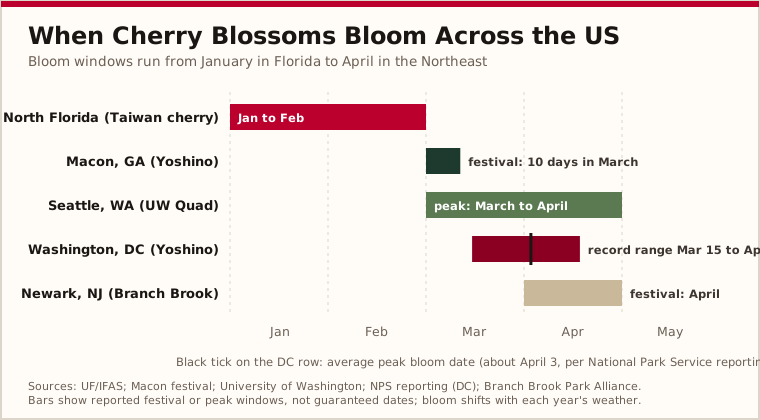
Bloom is a week-to-week affair: a warm spell can pull it forward by days. According to the EPA, as reported in news coverage, DC's peak bloom has shifted about eight days earlier since 1921, when records began.
Where to See Cherry Blossoms in the US
| Place | What you will see | When | Source |
|---|---|---|---|
| Washington, DC (Tidal Basin) | About 3,700 mostly Yoshino trees | Peak averages around April 3 to 4 | National Park Service reporting |
| Macon, Georgia | More than 350,000 Yoshino trees (festival's figure) | 10-day festival in March | Macon cherry blossom festival |
| Newark, New Jersey (Branch Brook Park) | More than 5,300 trees in 18 varieties | Festival in April | Branch Brook Park Alliance |
| Seattle, Washington (UW Quad) | About 30 Yoshino trees | Typically March to April | University of Washington |
Visiting is also a good way to learn which varieties thrive near you. Photograph a tree you like, read the label, and ask the garden centre what they stock locally.
What to Do Next
- Find your exact zone by ZIP code on the USDA map.
- Run the matcher and note which cherries show "Good fit".
- Check heat and chill against your own climate, not just your zone.
- Ask your county Extension office which flowering cherries do well locally.
- Plant at the right time and depth, mulch, and water young trees well. For planting steps in a hot climate, see my Florida guide.
If you would like a dedicated guide for your state, tell me which one via the contact page. I will write a state guide only when I can say something specific, such as how Texas heat and chill hours change the choice.
You can also read about whether cherry blossoms are edible, how Japanese gardeners place trees and stones, or browse my Japanese garden design guide.
FAQ
Where can cherry blossom trees grow in the US?
Across most of it. Flowering cherries are listed for USDA zones 4 to 9, which covers the Northeast, Mid-Atlantic, upper South, Midwest, Pacific Northwest and parts of California, Texas and the Southwest. They are poorly suited to zone 3 and colder, and to zone 10 and warmer.
What hardiness zones do cherry blossoms grow in?
It depends on the cherry. Sargent is listed for zones 4a to 7b, Yoshino 5a to 8b, Kwanzan 5a to 9b, Okame 6a to 9b and Taiwan cherry 7b to 9a.
Can cherry blossoms grow in Texas?
By zone, yes in much of the state. Texas spans roughly zones 6 to 10, and Okame and Kwanzan are listed up to 9b. Okame is heat tolerant, and NC State suggests shielding it from hot afternoon sun. I could not find authoritative Texas chill-hour data, so ask your county Extension office.
Can cherry blossoms grow in California?
California spans roughly zones 5 to 11, so many areas are inside the range of at least one cherry. Because the state varies so much, check your ZIP-code zone and local Extension advice.
Can cherry blossoms grow in Florida?
In North and part of Central Florida, with Taiwan cherry and Okame. See Can You Grow Cherry Blossom Trees in Florida?.
Can cherry blossoms grow in cold climates?
Sargent cherry is listed hardy to zone 4a, and Yoshino and Kwanzan to zone 5a. Zone 3 and colder is beyond all five trees covered here.
When do cherry blossoms bloom in the US?
From January in Florida to April in the Northeast. Washington, DC's peak has ranged from March 15 to April 18, with an average around April 3 to 4.
Do cherry trees need cold winters?
Most flowering cherries want some winter cold to flower well. Low-chill selections such as Okame are the usual choice for mild winters.
How long do flowering cherry trees live?
Taiwan cherry is relatively short-lived, about 10 to 15 years according to UF/IFAS. I did not find a lifespan for the other four in the sources I used.
Sources and How This Guide Was Checked
- Cherry zones, size, bloom and heat notes: NC State Extension Plant Toolbox pages for Sargent cherry (zones 4a to 7b), Yoshino cherry (5a to 8b), Kwanzan ('Kanzan', 5a to 9b) and Okame (6a to 9b); UF/IFAS for Taiwan cherry (7b to 9a; one fact sheet gives 7a to 9a) and the 'Akebono' Yoshino fact sheet ST-524 (5b to 8a).
- State zone spans: I took the union of two published state-by-state summaries of the 2023 USDA Plant Hardiness Zone Map (getgrowli.app and leafypixels.com) and rounded each to whole zones. The two summaries disagree by up to a zone at the edges, so my spans are deliberately generous, and I overrode Washington, DC to 7 to 8. The USDA map at planthardiness.ars.usda.gov is the authority for your own ZIP code.
- Bloom and place facts: National Park Service reporting for DC (about 3,700 trees, 70 percent peak-bloom definition, March 15 to April 18 range, average around April 3 to 4); the EPA for the eight-day shift; the Macon festival organisers for the 350,000 figure (their own count); the Branch Brook Park Alliance for 5,300 trees and 18 varieties; the University of Washington for the Quad's Yoshino trees (reports give 29 to 31).
- Not found: authoritative chill-hour figures for Okame, Taiwan, Kwanzan and Yoshino, and state-specific Extension recommendations for most states. Where I could not verify something, I left it out.
- Method note: the state "fit" labels compare each state's whole-zone span with the combined 4a to 9b range of the five cherries. They measure cold-hardiness overlap only and are not a promise that a tree will thrive.